
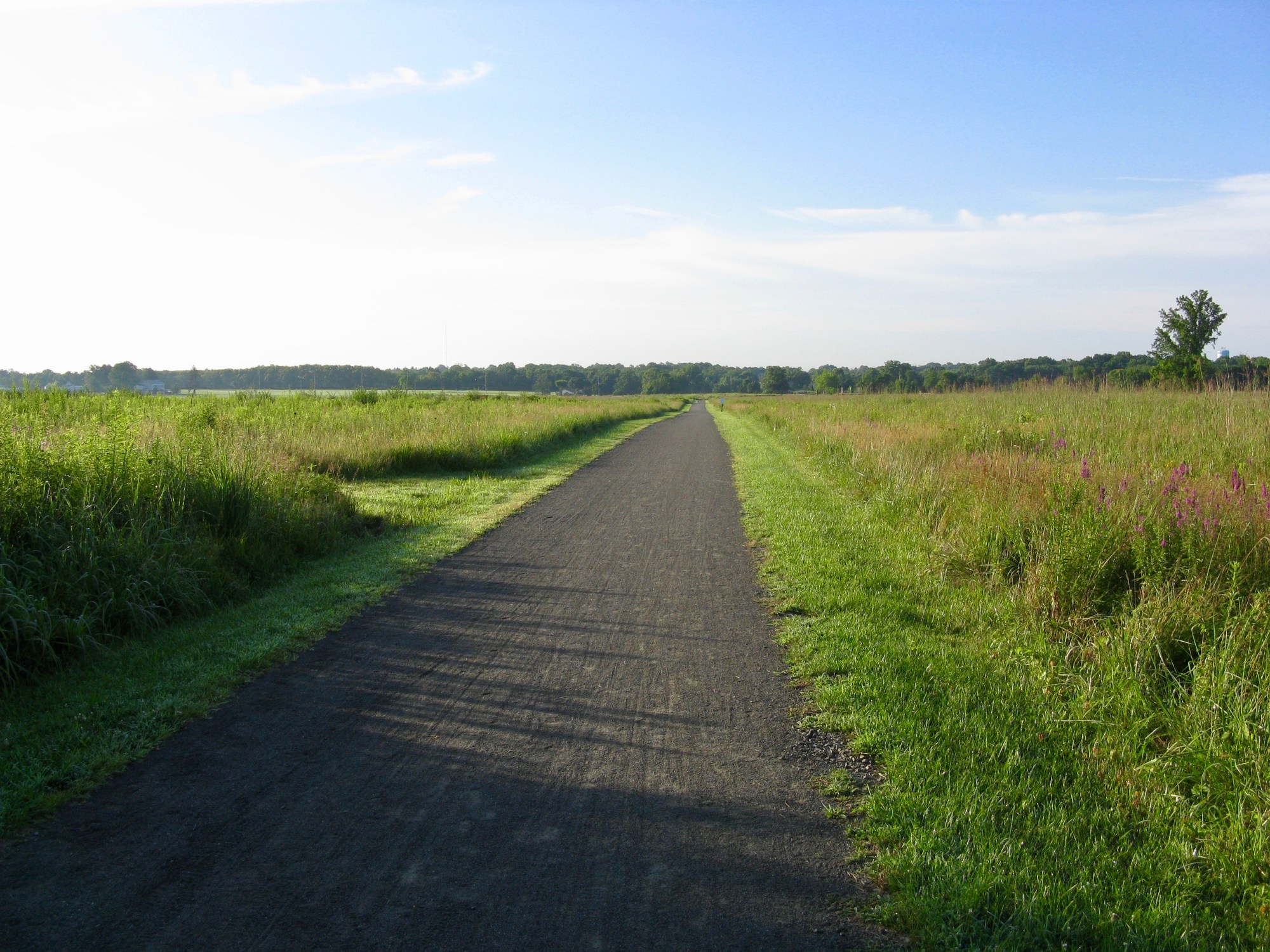
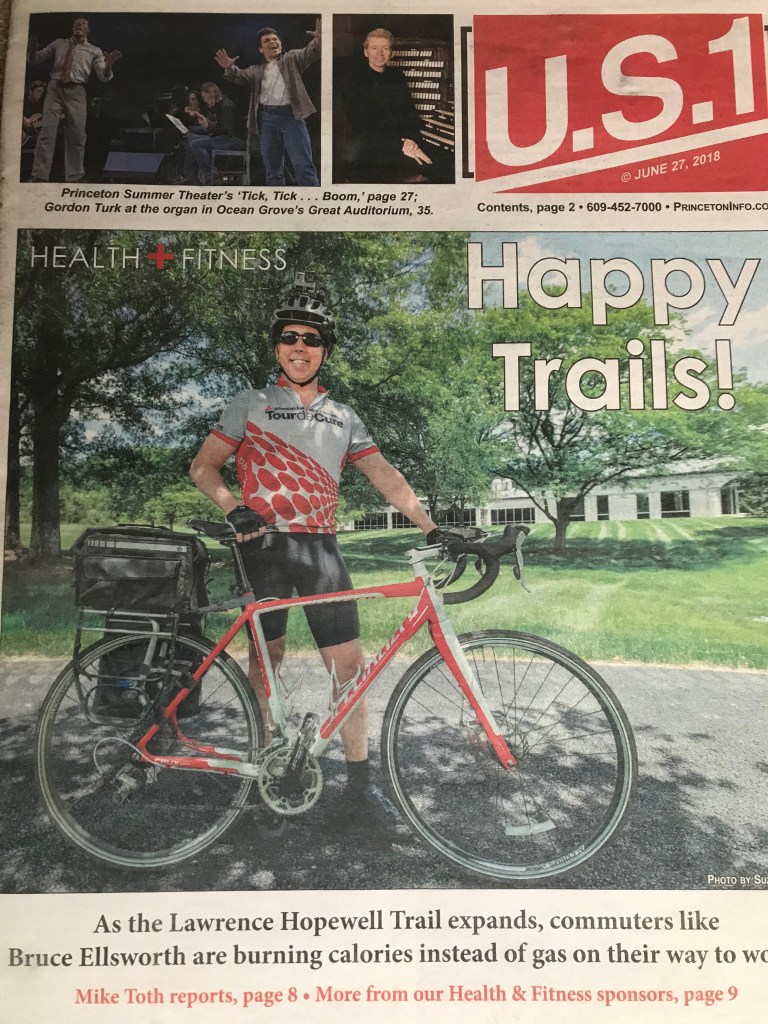
This story about the Lawrence Hopewell Trail was published in the U.S. 1 newspaper and in its sister Community News titles in June 2018. Writing it was great fun, and I met many wonderful people in the process. Plus, it gave me an excuse to ride the entire trail, during the week, in the name of research.
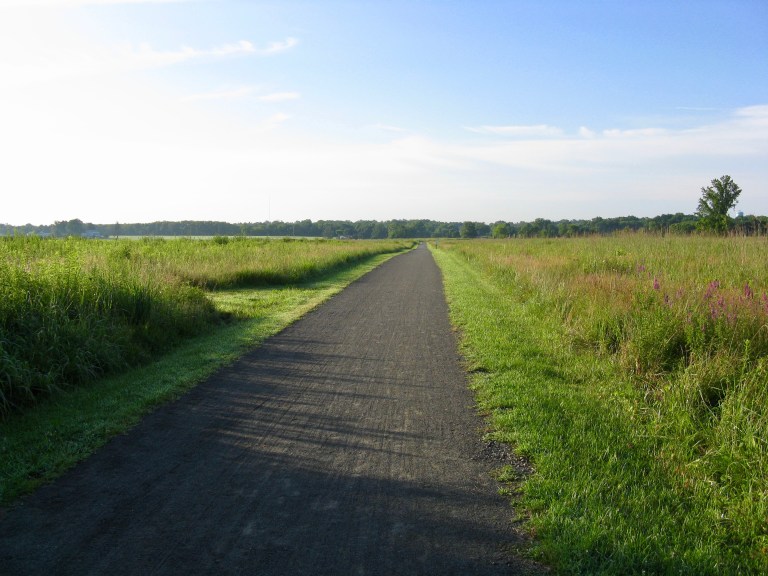
A view of the Lawrence Hopewell Trail in Mercer Meadows, looking southeast.
Scientist Bruce Ellsworth gets his best ideas when he’s operating a device that was invented two centuries ago.
Ellsworth, the head of Fibrosis Discovery Chemistry at Bristol-Myers Squibb, lives in West Windsor. While thousands of drivers are careening down his town’s Alexander and Washington Roads on the way to Princeton Junction train station every weekday morning, battling over narrow, scarce parking spaces and then warily navigating the treacherous commuter warrens of Penn Stations Newark and New York before actually getting to work, Ellsworth is going in the opposite direction, pedaling his bicycle along a bucolic stretch of the Lawrence Hopewell Trail.
“Earlier this week I saw American goldfinches for the first time this year,” Ellsworth said recently. “I’ve stopped and snapped photos of sunrises. The sights are amazing.”
Ellsworth began working at BMS in 1988 after earning a PhD at University of California Berkley and doing postdoctorate work at UC Irvine. Spotting songbirds, watching foxes, and yielding to herds of deer and other wildlife (“Once I saw a beaver!” he says) have been part of Ellsworth’s workday since 2000, when he began making the bike commute. Riding on the LHT, the 14-mile route to BMS Pennington is a bit under an hour in comfortable temperatures, a bit over an hour in winter.
While Ellsworth is a long-time bicyclist and riding advocate, he credits the LHT with not only making making him a higher-performing employee, but also with enhancing his mood.
“I am just a much happier person when I get home, even more so when I’m on the LHT,” says Ellsworth. “The most interesting thing about riding is the serenity, and being away from traffic. I’m reminded of a passage in Zen and Art of Motorcycle Maintenance, that when you’re sitting in a car, it’s like you’re watching TV. You don’t notice things like the color of fall leaves unless you’re out there on a bike, or walking.
“It makes me happy!”
It makes Becky Taylor happy, too.
The Trail Blazer
Becky Taylor is the founder and co-president of the LHT, a 22-mile loop trail through Hopewell and Lawrence Townships (18.7 miles are complete and open to the public, the remainder is estimated to be completed in two to four years). Taylor was senior director of the corporate and business communications department at Bristol-Myers Squibb when she originally conceived the idea.
As the former communications director and press secretary for Governor Christine Whitman and who now owns her own public affairs agency with an office in Lambertville, Taylor has the knowledge and skills to get people motivated to do something.
But the inspiration for the LHT didn’t originate solely from a strategy meeting in a conference room.
As a resident of Hopewell Valley, Taylor had been bothered by the fact that there was no good way for kids to be able to connect with their friends if they didn’t live in the exact same neighborhood. “It wasn’t safe to ride a bike on the roads in a lot of areas,” says Taylor, a mother.
A visit to Stowe, the renowned Vermont outdoor recreation town that’s laced with hiking trails and paths, helped spawn the idea. “There are lovely winding trails connecting everything there,” says Taylor.
And then there was the accident.
“ At one point, when we were living in Hopewell Borough, my husband was riding a bike up 518 from the Borough toward Rocky Hill, and an elderly woman driver hit him on his bike and threw him on the side of the road.
“He was lucky that he lived, no broken bones. But it scared me.”
More inspiration, certainly unpleasant, but it helped lead to her vision. “It all kind of came together after that,” says Taylor. “I was working at BMS in 2001 and we had three major facilities in the area. When we dealt with appointed and elected officials, and the townspeople, and the county, sometimes there were concerns about the impact we had on roadways.
“At the same time we were looking for ways to clearly demonstrate our commitment to being good corporate citizens. We thought a good way to do that would be to see if we could engage others in a joint project. We were looking to, number one, create a trail for biking. But we also wanted to change in a positive way the dynamics of regulator and ‘regulatee.’ We wanted to get to know each other as people.
“We thought that working on a project together, side by side, would be a good way to enhance community relations. That was as much of a motivator to the company as actually building the trail.”
In February 2002, Taylor took what she calls “a crazy, bold step” and invited representatives of Hopewell Township, Lawrence Township, Mercer County, the state Department of Transportation, the Department of Environmental Protection, and other key community players to a meeting.
“We said we have an idea that all of you might want to work on together,” remembers Taylor.
“Everyone showed up. We had 30-35 people there. It was unbelievable.”
A Long and Winding Road
Taylor knew that interest in the trail was one thing. Long-term commitment was another—and she found it in Mercer County Executive Brian M. Hughes.
One of the first meetings we had was with Brian,” remembers Taylor. “He looked at Eleanor (Horne, the other co-president of the LHT) and me and said ‘Nobody believes that you’re going to do this. Nobody. I’m not sure I believe it.’”
But Hughes has remained a steadfast supporter throughout the project. “Frankly, I thought the proposal was daunting, and it actually was,” says Hughes. “Yet I was captured by the enthusiasm that Eleanor and Becky brought to the table. Despite their inexperience, they were persuasive and passionate, and very quickly garnered public and private support.”
Hughes’ unwavering backing provided Taylor with faith when she and Horne encountered numerous challenges along the way—especially when trying to carve a trail through the Carson Road Woods, which is now a 183-acre public preserve right next to BMS Lawrenceville.
“BMS had just spent a million dollars to preserve that piece of property, because a developer wanted to go in there and build houses,”says Taylor. “The homeowners in the area didn’t want that. BMS didn’t want that. The D&R Greenway came up with funds to buy the property, and BMS came up with the last million.
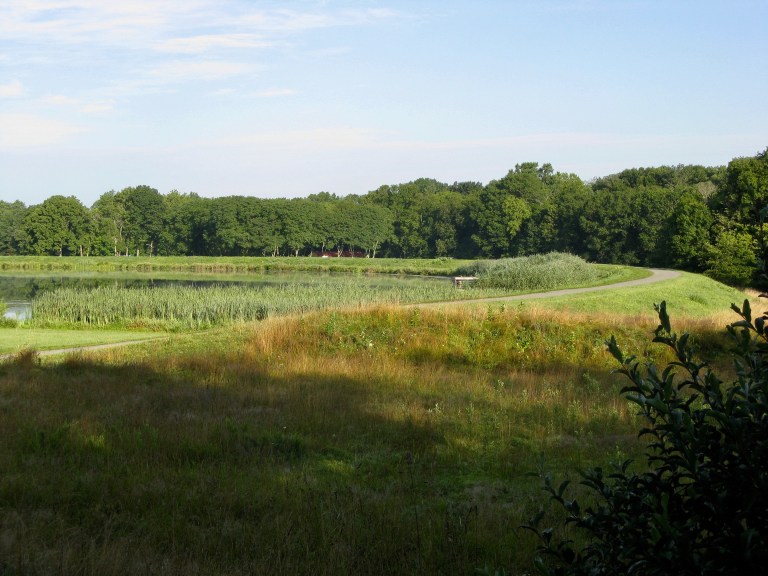
The LHT as it wraps around the northeastern side of Rosedale Lake.
“Then, when we said we wanted to put the trail through there, not everyone was enthusiastic about it. One homeowner in Carson Road Woods said ‘This is a trail to nowhere,’ and did everything he could to fight it. He pressed local officials so they would not approve the trail going through the property…after all these funds were spent to preserve it. The naysayers there prevailed for years.”
Fortunately, negativity was not the norm. “Down the road, in the Foxcroft neighborhood, we had the total opposite reaction,” remembers Taylor. “Homeowners were delighted. One of the neighbors hosted us for a community meeting, the neighbors came in, we talked about what we’d done, what we wanted to do, and they were delighted. Same thing at Princeton Farms off of Pennington Rocky Hill Road. They couldn’t have been more welcoming of us.
“On the other hand, on another section of the trail, owners of a farm that was on a critical portion of the trail—we couldn’t go around it—they just just did not want the trail to go through there. We finally got our approvals,” says the patient Taylor.
“It took 13 years.”
Value
No one owns the Lawrence-Hopewell Trail (see sidebar, “LHT at a Glance,” on page XX). As Taylor puts it, the LHT is a “public-private compact, the first of its kind.” An intrinsic value has not been determined, but County Executive Hughes points out that the worth of the LHT is manifested in several different ways.
“The trail adds value as a community amenity, both in increased property values along the trail and as a recreational resource,” says Hughes. “The trail has created stronger relationships between Lawrence and Hopewell Township officials and residents, as they have a common goal and resource to focus upon.
“The increase in property value is anecdotal, but it is consistent with studies that have been done elsewhere on this subject,” says Hughes. “We know that Realtors now advertise the proximity of a home to the trail as a selling point.”
Beth Kearns, a real estate agent with Callaway Henderson Sotheby’s International Realty, does just that. Kearns lives in Lawrence and moved back to the region with her husband in 2002, to raise their children in the area they both grew up in, and love. The LHT is key, because it factors in both her personal and professional life.
“I’m on the trails every single day with either our kids or our dog, walking or biking,” says Kearns, who was an executive at Hearst Media before getting involved in the real estate business. Kearns participates in numerous local activities, from serving on the Board of Directors at the Trenton Country Club to being PTO president of Lawrenceville Elementary School, and knows first-hand how significant the LHT is to residents.
Kearns says that she points out the trail and its “tremendous value” to the area to clients all the time. “People who are new to Lawrence are amazed,” she says. “They don’t realize that the trail is there, and they can’t believe it. It’s a huge added bonus; a real luxury. I explain it to them and they’re like, ‘What? Wow!’
“I tell people that the most amazing things about the area are the access to Philly and New York, the beaches, the Poconos–and these trails in your own backyard,” Kearns adds. “They are a way to connect everyone. And they will become a part of your life here.”
Hooking Up with the Locals
Of course, the value of any road or trail stems directly from its use. It has to go somewhere that people want to go.
That’s why connections are key to the success of the LHT, which links to the Mercer Meadows trail system, the Pennington Connector Trail, and the D&R Canal Trail. Those connections provide direct access to the LHT for thousands of area residents.
Ellsworth the scientist, who lives within walking distance of the D&R Canal trail in West Windsor, is intimately familiar with the need for connectivity. “ If I live 10 miles of horrendous roads away from the LHT, I’m not going to ride it. But with the connecting D&R Canal Trail, the connection for me is nearly seamless.”
When Ellsworth was based at the Pennington campus on Pennington-Rocky Hill and Titus Mill Roads, he would take the LHT nearly all the way. He’s begin his going-home route by taking the trail south along Pennington/Rocky Hill and Old Mill Roads, go around Rosedale Lake, cross Blackwell Road into Mercer Meadows, follow the trail across Keefe Road and into Village Park, down through the Lawrenceville School and across Lewisville Road, and then take a connecting trail to the D&R Canal Trail, which would bring him nearly home to West Windsor.
These days, Ellsworth works at the BMS location on Carter Road in Hopewell Township. He still occasionally rides there, though the route puts him on more roadways (“The worst part is the intersection of Carter road and Elm Ridge Road. The road is narrow, there’s no shoulder, cars coming up 50 mph in your face…people have been very kind, they give me space,” Ellsworth says). The remaining unfinished leg of the LHT will, once complete, allow Ellsworth to take the trail through the Educational Testing Service property and up to his new location.
Becky Taylor says that Mercer County is now trying to make even more connections throughout the region. And those connections will link to more than neighborhoods and corporate campuses.
“If you ride to Brearley House on the LHT and connect with the D&R Canal trail, you can go to Maine or Florida,” says Taylor.
That’s because the LHT and D&R trails are part of a larger trail system called The Circuit Trails (circuittrails.org), a continually growing network of trails in New Jersey and Pennsylvania that in turn is part of the 3000-mile East Coast Greenway trail system (greenway.org).
But maybe you don’t want to bike to Key West right now, or can’t afford the time it would take to pedal to your job in Jersey City. Maybe you just want to go for a walk and get some exercise. You can do that on the LHT, and many people do that now.
Popularity and Use
LHT co-president Eleanor Horne says that a counter on the trail at the Keith Road entrance to Village Park indicated that that one segment—which is not the most heavily used segment of the LHT—gets 69,000 user visits in a year. Horne extrapolated that figure to come up with an estimate of 1.2 million user visits annually for the entire trail.
“The counter can distinguish between walkers and bikers,” says Horne. “Some trail segments might have more bikers than walkers and some more walkers. We know that 60 percent of our users are walkers and 40 percent bikers.”
It’s also known that Bruce Ellsworth isn’t the only bike commuter on the trail. ETS Spokesman Tom Ewing says that about a dozen employees bike their way to work, and easily half use the LHT to get there. “The route through Carson Road Woods is the most heavily traveled by ETS bike riders coming from the south,” says Ewing.
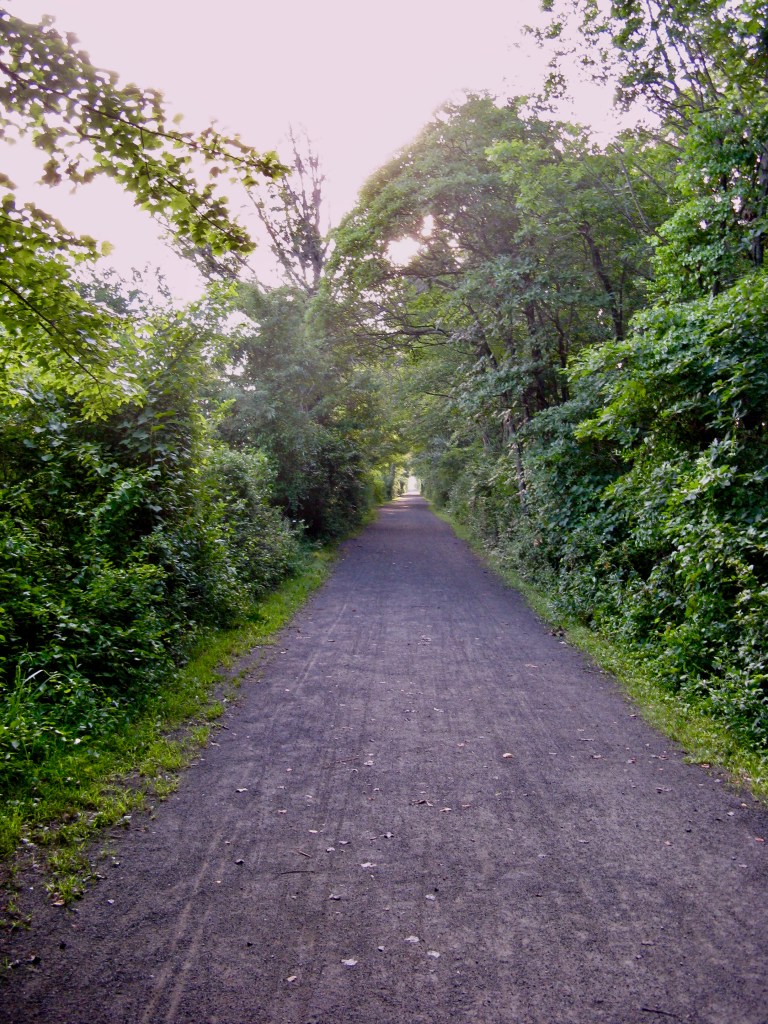
Trees and brush form a canopy over the Lawrence Hopewell Trail near Keefe Road.
BMS has 30 regular bike commuters among its three area locations, according to Director of Community Affairs Lisa McCormick Lavery. BMS also provides a bike share program out of their Princeton Pike and Route 206 locations. “The point is to get people out of the office, out of meetings, let them get on the trail and clear their heads and get some exercise,” says Lavery, an avid user of the trail herself. And that’s the other aspect of the trail that’s so important to so many residents.
Fitness for Everyone
Horne says that the trail was designed to be family-friendly and handicapped-accessible to the fullest extent possible. “It is not the kind of trail that a Lance Armstrong might want to ride,” says Horne. “It is designed for young children, families, senior citizens.”
And it provides more than just a place to work out, Horne notes. “You can ride an exercise bike or run on a treadmill in your basement or a gym, and burn the same number of calories or rack up the same mileage. What you will not experience is the glory of being outside, of feeling a breeze on your face or the warmth of the sun. You will not pass through a canopy of trees and emerge by Rosedale Lake. You will not hear birds chirping or see a butterfly.”
“You will not,” says Horne, “restore your soul.”
Which Bruce Ellsworth knows very well.
THE LHT AT A GLANCE
What is the LHT?
The Lawrence-Hopewell Trail is a 22-mile public trail through various public and private properties in its namesake towns. The trail is designed to connect Lawrence and Hopewell Township residents to businesses, neighborhoods, and other towns without using a motor vehicle and without walking or riding on major roadways. The trail is 85 percent complete and is composed of asphalt or compacted stone dust.
Who owns the LHT?
No one owns the LHT. Property owners and public entities have all agreed to allow the trail to run through portions of their lands.
Who manages and maintains the LHT?
The nonprofit Lawrence Hopewell Trail Corporation manages and is responsible for maintenance of the trail. It is governed by a 17-member board of trustees, whose members reside in Hopewell or Lawrence. (For details, go to lhtrail.org.)
How is the LHT funded?
Funding comes from public and private sources, including individuals, private foundations, and corporations. The largest private donor is Bristol-Myers Squibb, and Educational Testing Service is another generous donor. The Delaware Regional Valley Planning Commission has funded projects with grants supported by the U.S. Department of Transportation and the William Penn Foundation. The N.J. Department of Transportation and N.J. Department of Environmental Protection have provided significant grants. (Securing operating expenses is the LHT’s biggest financial challenge, since many public and private funders will not cover those costs.)
Who can use the LHT?
The trail is open to walkers, joggers hikers, bicyclists, and skaters. (Horses are allowed on the section that runs through Mercer Meadows.) Dog walking is allowed; owners must keep dogs leashed at all times, and waste must be removed. No motorized vehicles are allowed.
When is the LHT open?
The LHT is open year-round, from dawn to dusk, weather permitting.
When will the LHT be completed?
It’s estimated that the trail will be complete in two to four years.
 miketoth.net