
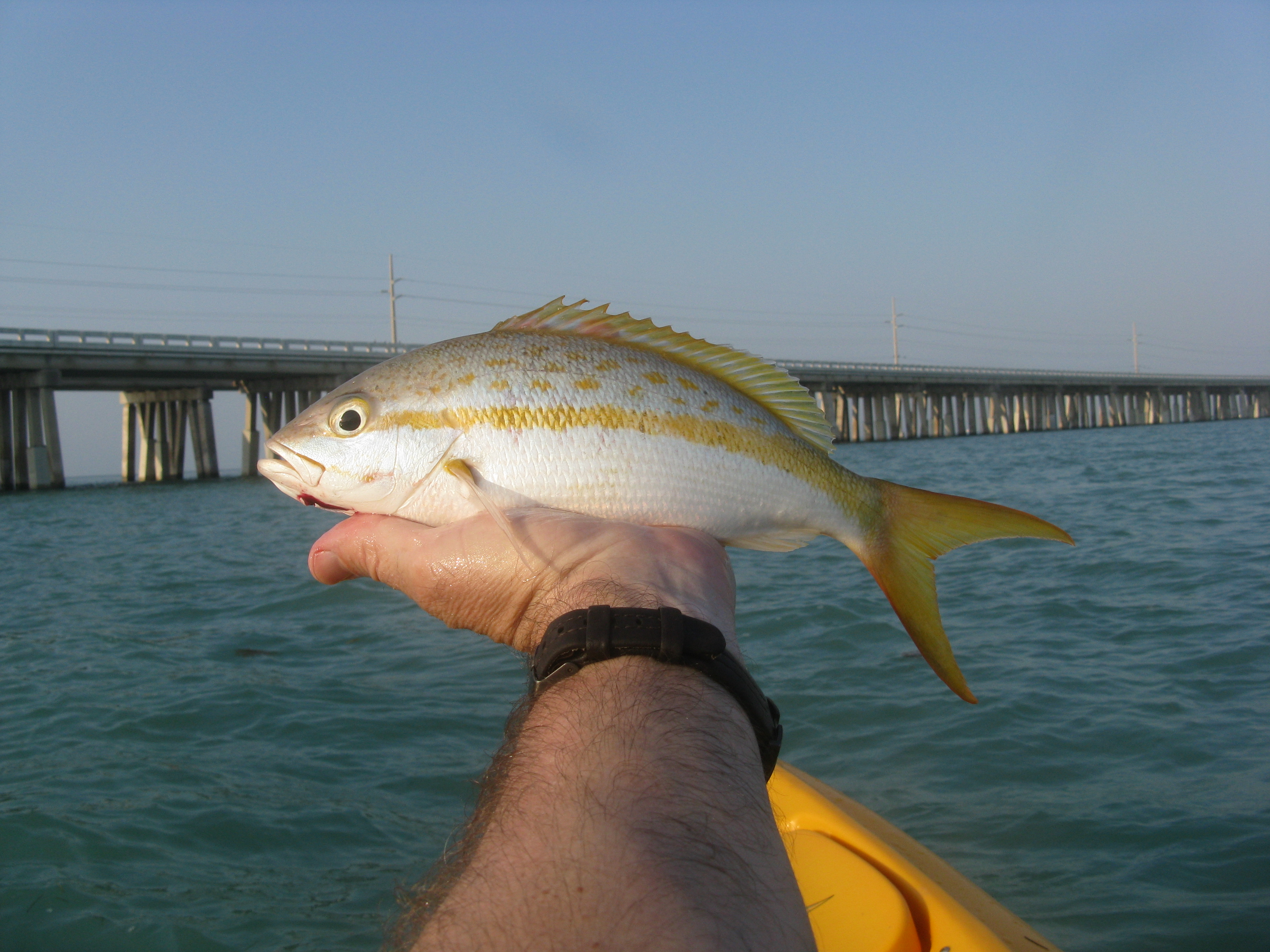
The challenge: Can two fishermen escape the icebound Northeast and find warm water, solitude, and fantastic fishing all on their own for dollars a day? My friend John and I wanted to find out. (The yellowtail snapper I’m holding above, caught in Boca Chica Channel in the lower Keys, hints at what we learned.)
March 2010, central New Jersey. Dirty gray skies above. A foot of crusty snow on the ground covering another compacted 4 inches from February that never melted. Buried under it are my kayak and any desperate hope for an early start to using it.
I’m visiting my friend John Braun. We’re drinking coffee at his kitchen table, carping about the weather and failing to get enthused about the stripers and fluke we’ll go after in Barnegat Bay from our kayaks–if the snowpack ever recedes.
Both of us have houses that aren’t paid off, kids in college, and wallets bulging with credit card receipts. As much as our souls need it, neither of us is in a financial position to fly to Abaco, get poled around a white-sand bonefish flat by a smiling barefoot guide, and recount the adventure during a mango-colored sunset over minty mojitos in a tiki bar. So instead we stand in our damp garages with cans of beer and replace corroded treble hooks while wet snow pelts the windows.
“We need to get out of Jersey next winter,” I tell John. “Find some warm weather and a lot of fish. That we can kayak to. Do it ourselves.”
John, who has been tearing apart reels and building rods through four blizzards, doesn’t even take a glance at his wife sitting next to him. “I’m in.”
That’s settled. Now all we have to do is find a place we can afford.
March 2011, Big Pine Key, Florida Keys. The sign on the small trim building next to the dock says BEER BAIT TACKLE. A bridge with splayed concrete pilings crosses the aquamarine water beyond. The sign at its foot reads NO NAME KEY. It is 83 degrees and palm fronds rustle in the occasional breeze. We see no cars. We hear no airplanes. We see no people except for a man and woman sitting near a large outdoor bait tank, gazing out at a small lagoonlike marina.

John Braun paddles to a small mangrove island off of Big Pine Key.
All of our research the past year–the weekend phone calls, the e-mails from the office, the surreptitious texts during family dinners and business meetings–has led us here, to Old Wooden Bridge Guest Cottages and Marina.
“Let’s get the rods out,” says John, hungrily eyeing the bridge pilings.
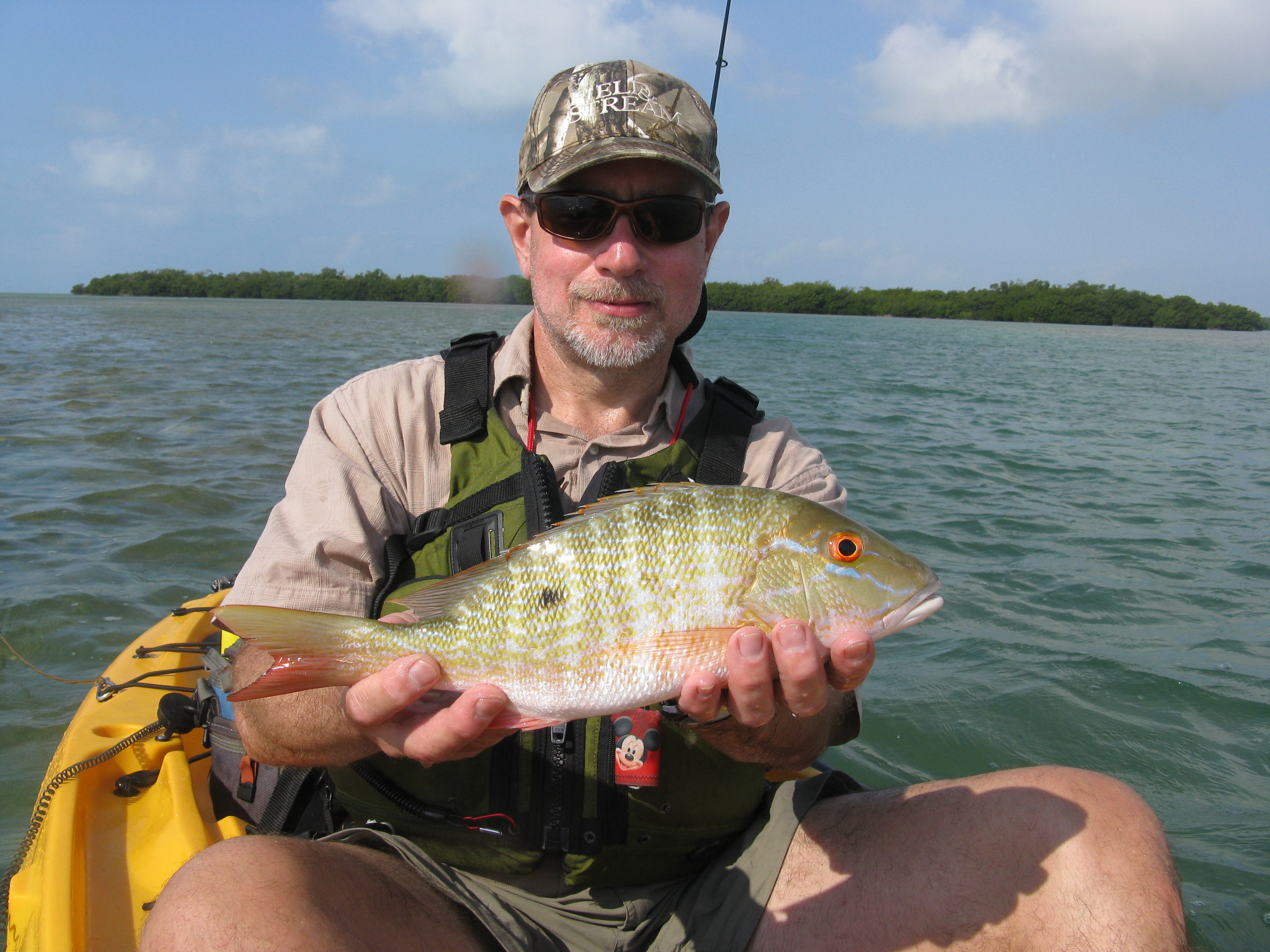
The author with a mutton snapper, caught from a kayak near Geiger Key.
We’ve come loaded for bonefish, tarpon, and permit, those popular and charismatic Keys trophy species. What will be yanking those rods over the next seven days here, however, are fish that couldn’t be more perfect for two frugal kayak anglers looking for a thrilling fish fight–along with delicious fillets to bring home–in miles of water with no other fishermen in sight.
Someone Forgot These Keys
A popular tourist and fishing destination off the southern mainland tip for nearly a century, the Florida Keys see 2.5 million people every year moving down the chain of islands to visit resorts, motels, restaurants, and marinas. Fishing, boating, diving, and doing nothing in the warm sunshine are their primary goals. Many tourists, once they’ve passed through historic Key Largo, sportfishing-famous Islamorada, and laid-back Marathon, cross over the Seven Mile Bridge and race the 35 miles down U.S. 1 to Key West, where cruise ships dock, spring breakers dance in the streets, and clothes (and more than a few previous lives) are occasionally discarded.
Hidden off that route to Jimmy Buffett’s inspiration for “Margaritaville” are the Lower Keys, which differ from the other Keys not only in ecology and culture but in identity as well. The island chain widens south of Marathon, with much of the landmass hidden from the road. It’s an area that resembles the Everglades with its rich vegetation, sources of freshwater, and abundant wildlife.
What few resorts and restaurants found here cater to campers, fishermen, and families that don’t desire or can’t afford the five-star upscale resort experience.
“We’re the hicks of the Keys,” says Bonnie Tillman, who was one of the people sitting by the bait tank and will sell you, if you’re polite, that beer, bait, and tackle. Indeed, looking around, it’s as if several dozen chunks of rural Florida, people and all, broke off from the mainland decades ago, drifted 60 miles, and got stuck on a reef.
Those chunks, with mile after mile of undeveloped shoreline, make outstanding fish habitat.
A Hidden Subtropical Wilderness
The entrance to the mangrove-lined creek is a deceptively welcoming 15 feet wide. But it progressively narrows as I pedal. Now, at its end, junglelike croaks and cries come at me from all directions. In the water, hidden in the forest of forearm-thick mangrove roots, are schools of gray snappers, referred to as mangrove snappers down here. Other than John, whom I’ve left at the mouth of the creek, there’s no one else here. Or within a mile of here.
Bill Keogh, part owner of Old Wooden Bridge and the proprietor of Big Pine Kayak Adventures, sent us here after instructing us in the ways of mangrove snappers.
“A mangrove island is like a mushroom,” he’d said. “Leaves and branches extend out over the water, but the submerged roots are much narrower. The snappers will come out of the roots to hit a shrimp, but you have to drop your bait under the canopy, within inches of the roots.”
Early this morning, we’d left our housekeeping cottage at Old Wooden Bridge and pedaled our 12-foot Hobie Mirage Outback kayaks along Bogie Channel, fish our way to No Name Key’s south end. There, in a shallow bay just within sight of Bahia Honda bridge, Keogh said we’d find a tiny uninhabited key bisected by a creek full of keeper mangrove snappers. “It’s close quarters,” he’d told us. “You won’t need to cast much.”
That was an understatement. In casting terms, what starts at the creek’s mouth as an underhanded lob to the opposite bank quickly evolves to a flip with the rod tip. It’s similar to fishing an ant fly tight to a wooded bank on a trout stream—cast too close the bank and you’ll snag the overhanging branches, cast too shy and you’re out of the zone.
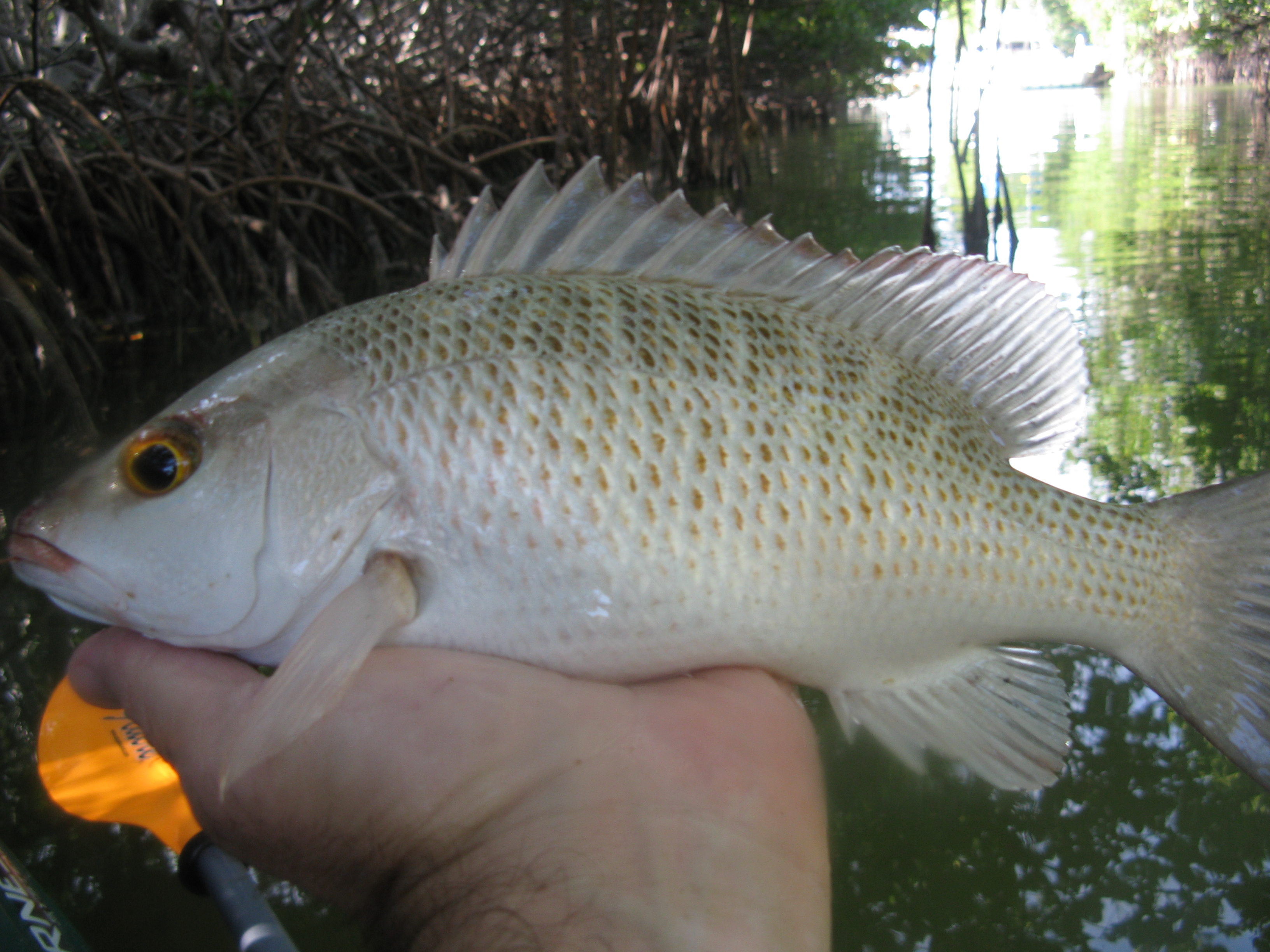
A pretty mangrove snapper from a mangrove creek. These fish will exhibit varying colorations depending on their habitat.
Here, if your cast is accurate, you may see one or more snappers race out of the roots to get to your live shrimp. The impossibly strong fish will bow your rod and peel line off your spool as they turn to go back the mangrove roots—if they don’t clean your hook first, which happened to me time after time.
I fish my way up the creek, losing more shrimp as I go. Now I can’t paddle any farther, and I’m out of live bait. I add a fresh two-foot length of 15-pound-test fluorocarbon onto my line, tie on a 2/0 Owner circle hook, and squeeze a small split shot a foot above it. After baiting up with a 3-inch Gulp shrimp, I reach out to where the creek is no more than a foot wide and flip it in.
A foot-long snapper is a blur as it rushes out the roots and grabs the fake. My St. Croix pack rod bows and two feet of line peel off the spool as the fish speeds back to the roots. I quickly raise the rod and turn the fish just as it enters the shadows, wrestling it into what little open water there is. A few seconds later the fish is flopping at my feet—a fat mangrove that, as I will find, tastes even better than the more famous and commercially available red snapper.
The ruckus has put off the fishing in the corner, so I pedal back to John, He’s heading my way with a 13- and 14-incher that he’s caught in the same manner. “There was a bigger one with the 14,”he says, but I couldn’t get him to come back out of the roots.” Still, we are more than halfway to dinner.
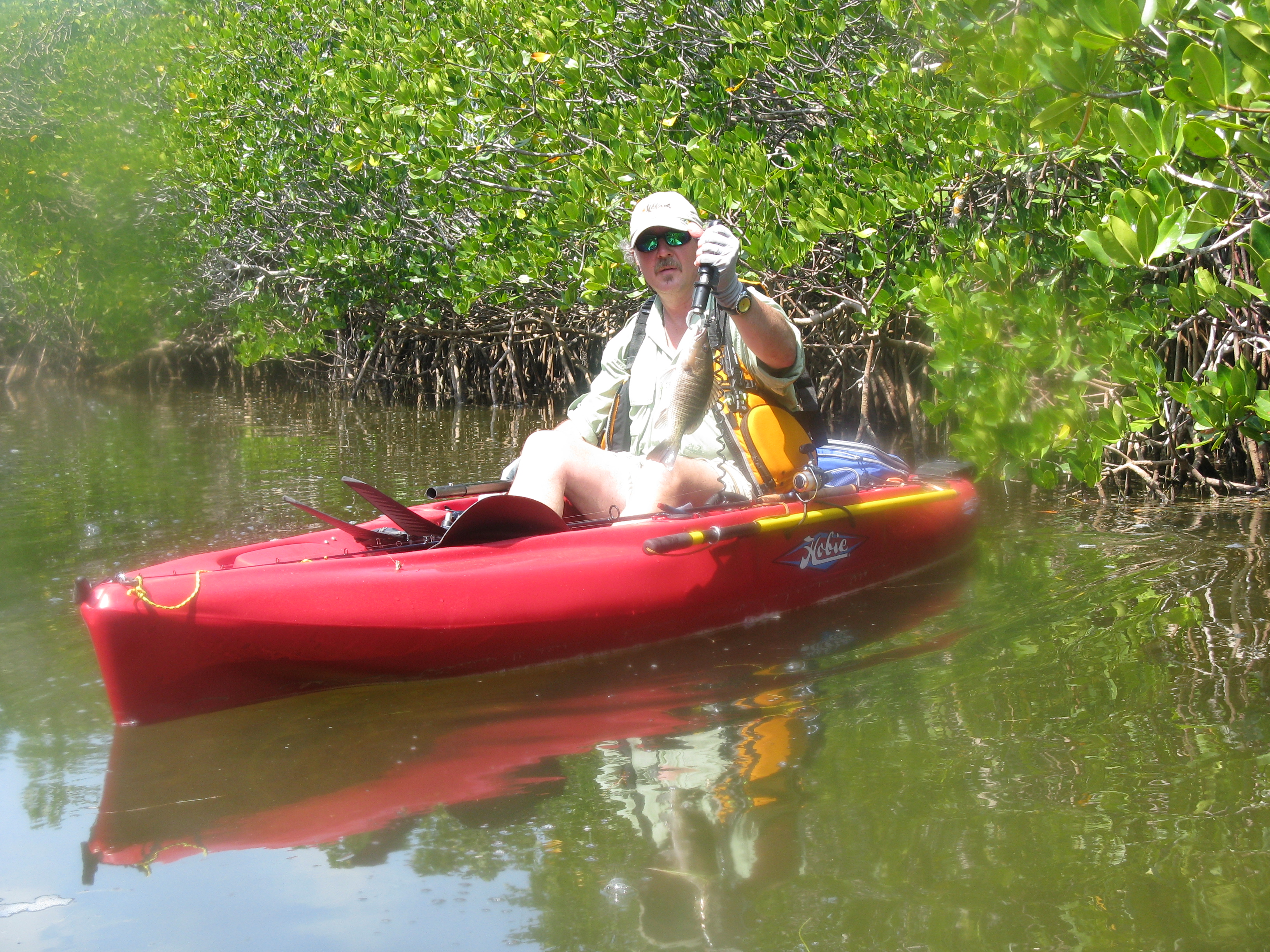
John with a mangrove snapper that he lured from the mangrove roots with a shrimp.
We pedal out of the creek and find a 15-foot-deep sand patch adjacent to another small mangrove island. “Every little sand patch around the mangroves has snappers on it too,” Keogh had told us. They’ll wait in the weedy edges and ambush prey as it passes over the light-colored bottom.” This looks like what he’d been talking about. I add another split shot to my line, bum some shrimp from John, bait up, cast out, drift 5 feet, and almost have the rod yanked out of my hands.
“Big snapper!” I yell. The fish tows me toward the mangroves, and I simply hold on. Looking down in the water I see the mangrove, easily a four-pounder, bulling his way to the roots. “We’ve got dinner and then some!” I shout.
And as soon as my whoop echoes off the mangrove thicket, the line pops.
I yell something else, and we drift in silence.
Tiny Deer = Epic Fishing
A major factor in the existence of all this water with comparatively few people is the key deer, an endangered whitetail subspecies native only to the Lower Keys. About 800 of them roam the region, swimming from island to island for water and forage needs. They’re not immune to attacks from sharks. A big key bucks weighs in at 75 pounds. Because they’ve lost most of their fear of man, about one deer per week dies in a vehicle collision; John and I had to swerve around an eight-pointer in velvet (the rut begins early down here) when we drove to the main road for supplies one evening.
The establishment of the 9,200-acre National Key Deer Refuge on islands throughout the Lower Keys helped protect the Key deer population—which at one point had dwindled to 50—from poaching and habitat loss. That refuge, along with the adjacent 7,600-acre Great White Heron National Wildlife Refuge and strict building restrictions on populated keys, also effectively curbed the rampant development seen elsewhere in Florida over the last century.
“A little deer has all the power down here,” Keough told us.
Those little deer also helped make fish, because innumerable mangroves, which provide precious fish habitat, were protected. “Fringing mangrove communities around the Lower Keys may be our most critical near-shore habitat,” says John Hunt, a marine biologist with the Florida Fish & Wildlife Commission and director of the state research lab in the Keys. “All the nooks and crannies in a mangrove system provide great protection for snappers, as well as for the crustaceans and arthropods they eat—all of which are fed and replenished by falling mangrove leaves.”
What’s more, all that wild, protected, outstanding fish-producing habitat in the region allowed a couple of Jersey kayak fishermen to have great fishing beneath an entire Florida Keys bridge all to themselves.
You Take the Gulf, I’ll Take the Atlantic
Keogh had mentioned a launch area at the base of the Bahia Honda Bridge where we’d have access to the deep, swift channels. There, the pedal-powered Hobie kayaks would be essential—we’d be able to work one hole or drift a likely stretch easily because our feet would control the kayak in the wind and current, leaving our hands free to cast and retrieve.
Around three hours before dark, we carry the Hobies down to the coral-studded shoreline and put in. Our bait buckets have plenty of live shrimp in them, and I also have a couple of blue crabs in case some tarpon show up.
The tide is running south to north—from Atlantic to Gulf—and we begin drifting from the pilings of the defunct 99-year-old railroad bridge to those of the U.S. 1 Bridge, a distance of about 200 yards. We start catching fish immediately—heavyweight blue-striped grunts (“grits and grunts” is well known meal for the more self-subsistent types in the Keys) and porgies.
I notice the edge of a sand patch on one drift and pedal back, lining myself up so my drift will take me straight over it. As soon as the sinker and shrimp hit that sand patch, the rod jerks over. I look in the water and see the now-familiar bronze flash.
“Mangrove!” I shout to John, who is drifting a stretch of water one piling over.
“Flag!” he shouts back.
“What?”
“Flag! Big yellowtail snapper! I just lost one!”
Yellowtail snappers from a kayak? I can deal with this. So can my freezer back home.
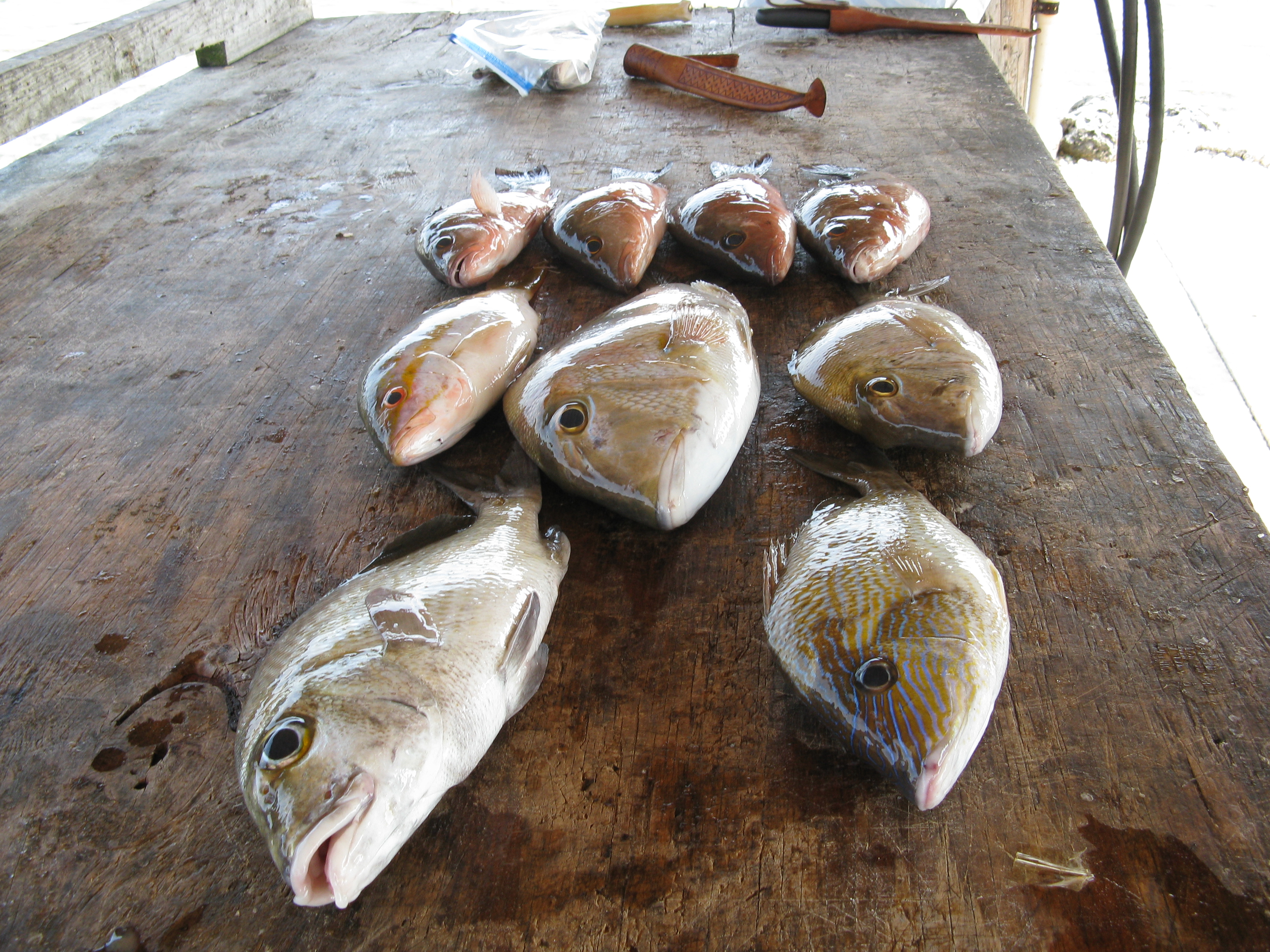
Our fish from one afternoon’s fishing on the fillet table at Parmer’s Resort.
We put a few keeper-size yellowtails in the kayaks, then the mangroves start biting again. John, however, wants to find his lost flag, so he pedals out to the midsection of the old bridge where the water is a bit rougher and the current somewhat stronger. Fifteen minutes later he comes pedaling back.
“Either someone is dropping cinder blocks into the water back there,” he says, a little wild-eyed, or something huge is crashing bait out there. Fourth piling.”
That old railroad bridge is cut off from the mainland, which can mean only one thing: tarpon. I grab my heavier rod, rig a crab to a 4/0 hook, and pedal out.
The Florida Keys are the accepted border between the Gulf of Mexico and the Atlantic Ocean. Though both bodies of water appear serene, even tranquil, from the roads and bridges and the shaded outdoor lounges during happy hour, things are different when you’re actually on that water. And out here, under the middle of the old bridge at sunset, with swells slapping powerfully against the aged pilings and the noise echoing hollowly off the span above you and nothing but ocean separating you from Cuba 90 miles to the south and the desolate Everglades marshes 30 miles to the north and who knows what swimming under your suddenly small 12-foot kayak—and no one around at all except your buddy, busily fighting a fish far away—you realize at once that the Keys are just tiny islands in the middle of a vast ocean.
I cast out my crab.
In a perfect angling world, a 100-pound tarpon would have inhaled the bait and taken me on what kayak fishermen call a “Nantucket sleigh ride,” in which a big fish you can’t control tows you fast enough to churn water from the bow. Although I will later learn that huge pods of giant tarpon moved through the Keys about a week after our departure, the fish that are here don’t want my crab.
And perhaps that’s a good thing. My Spanish is very rusty.
Fishing the Backside of Paradise
The island that borders Key West is Boca Chica Key, a romantic, tropical-sounding name belied by the fact that a U.S. Naval Air Station largely occupies the place. At the southern end of Boca Chica, however, is a hook of land that extends east. It’s called Geiger Key, home to some modest residences and the Geiger Key Marina, which bills itself as being located on “the Backside of Paradise.” Just the place to go for our last day of fishing before returning to the cold and damp Northeast.
We slide the kayaks down the sidewalk-wide ramp adjacent to the marina and pedal out. Again—as we’ve experienced all week—no one else is around. One reason is that much of the waters in the Lower Keys is shallow. Any boat with an outboard motor would have to stay in the channels to get to deeper offshore grounds, therefore would be forced to pass up a lot of great water lying behind flats and reefs and bars. When John and I encounter shallows that even our shallow-draft kayaks can’t navigate, we get out, pull them across, and climb back in.
After crossing a big flat, we consult our maps. We’d planned to fish a larger, deeper area about an hour’s pedal beyond, where Keogh had said we might find a permit or two, but now we see that our schedule won’t allow it.
I bait up with a shrimp and drift through a dropoff on one side of a sandbar. Tap…tap…bang! My rod bows and the fish starts towing the kayak. In a few minutes I have a beautifully hued mutton snapper in my hands.
But after a few hits from short mangroves, the fishing turns off.
“What do you think?” I ask John. “Start heading back?”
“Yeah, but let’s try that little island we passed on the way here. I think I saw some blue water near the shoreline.”
We pedal over, push stakeout poles into the bottom that we’ve lashed to our kayaks, and let out parachute cord as the breeze eases us over to casting distance. John is right—the water is a gorgeous sapphire blue where it meets the mangroves, and deep. It looks good…but it won’t be easy to drop a shrimp into the target zone at the edge of the mangroves.
I make a long, gentle lob. Bull’s-eye. Just as I close the bail, the line zips sideways. The drag tells me that I’m onto a keeper mangrove.
Once I get the fish in, I rebait and recast. A miss. Reel, recast, hit the zone, bam! Another mangrove snapper—this one, bigger than the first, buzzes the drag all the way in.
Less than an hour later I have my limit of five keeper snappers at my feet. I pull the stakeout pole and pedal over to John, who is unhooking a 16-incher. “How’d you make out?” I ask him…though I think I know the answer.

My limit of mangrove snappers in the Hobie Outback’s bait well…
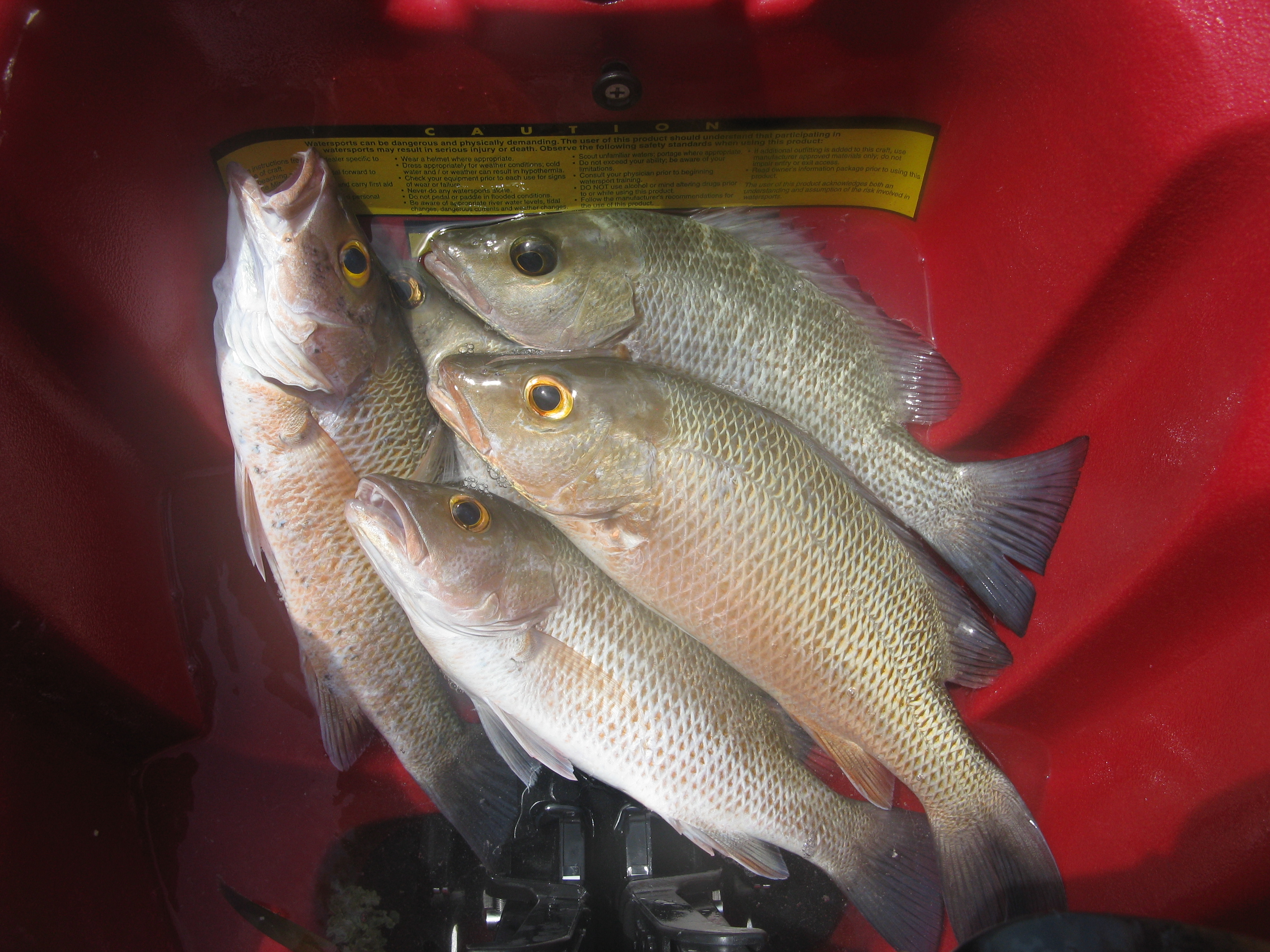
…and John’s limit, which he caught simultaneously.
He drops the fish into the pedal well. “I’m done.” I look into his kayak and see five big mangroves. “But this place is unbelievable! We need to come back. Get a shot at a permit.”
I look around. Palm trees, mangrove islands, water everywhere, no other anglers. I have fish at my feet. It is in the 30s back home.
“I’m in.”
FLORIDA KEYS KAYAK FISHING GUIDE
Kayaks
We used Hobie Outback kayaks equipped with pedal-powered MirageDrives to fish the Lower Keys. These drives, which operate fins beneath the hull, free up both of your hands to fish because your feet propel the boat. You can remain in one spot in the wind or current, or make a controlled drift through section of water, without putting your rod down. You can make adjustments to your direction by operating the rudder control, located on the transom, with one hand.
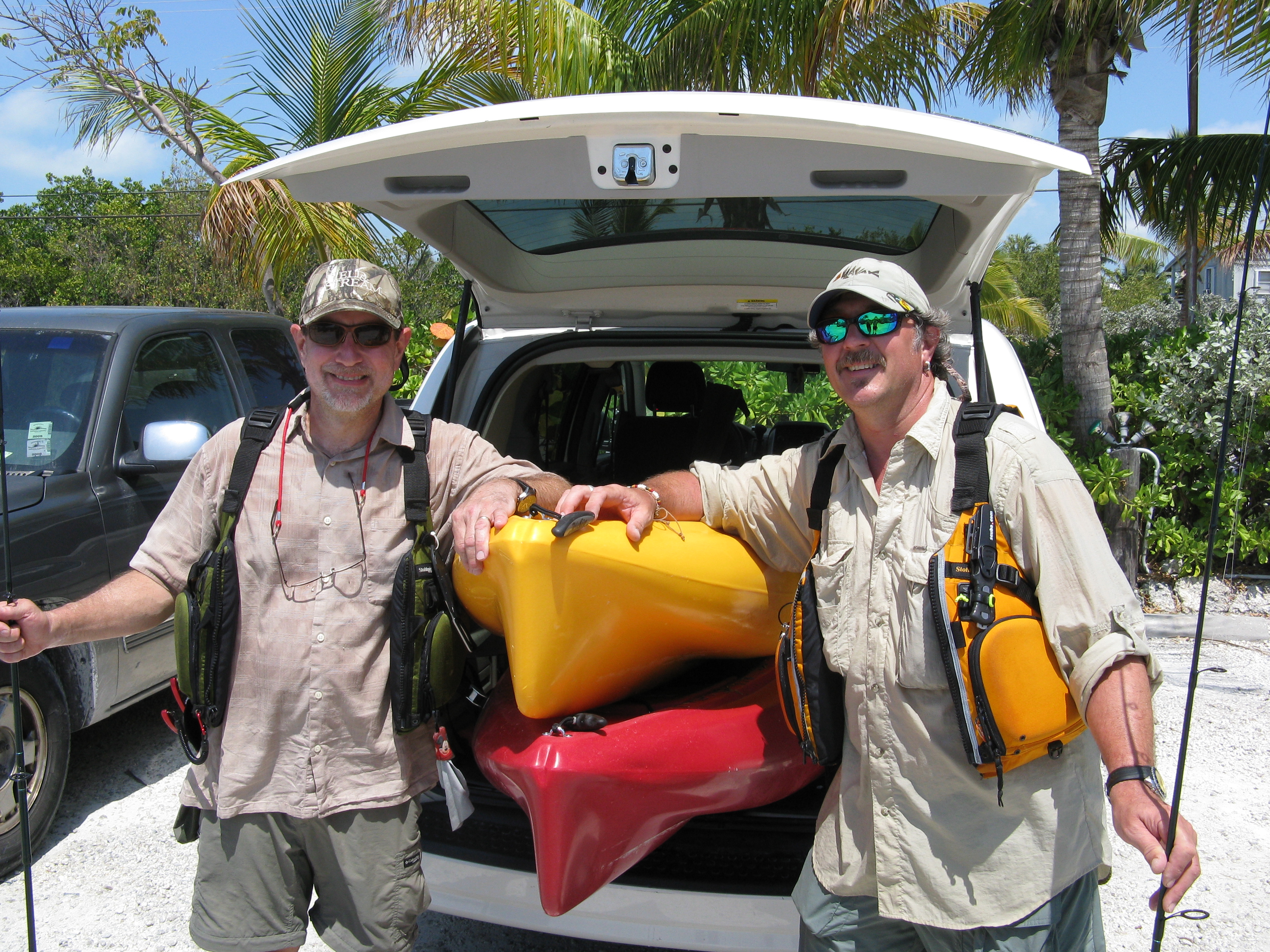
We were able to nest our rented 12-foot Hobie Outbacks right in the back of the rented minivan.
The Outbacks were essential to our ability to fish the bridges, where a fisherman in a standard kayak would have to paddle constantly to maintain control. With the MirageDrive you can navigate until you enter the shallowest of waters, at which point you simply remove the pedal unit and use a paddle.
Florida Bay Outfitters in Key Largo has a large selection of rental kayaks available.
Rods, Reels, Line
We used 7 ½-foot inshore saltwater travel rods by St. Croix and Abu Garcia reels loaded with 10-pound mono and 20-pound braid for our fishing. Kayaks get wet, so it’s wise to invest in a reel with a waterproof drag. We used 15-pound test fluorocarbon leaders for our snapper fishing, and were ready for bigger fish by packing spare spools loaded with 30-pound braid 50-pound fluorocarbon leaders. For the past several years I’ve been using PowerPro Super 8 Slick V2 braid for saltwater kayak fishing, and have found it to be ideal. It’s smooth, easy to handle, and neither too limp nor too stiff.
Bait
Everything in the Keys eat shrimp, and the fresher yours are, the better. Freshly dead shrimp are better than frozen, and Gulp shrimp will catch snappers. Circle hooks are required when fishing from a vessel. We used size 1/0 to 4/0 circles, depending on the size of the shrimp and what species we were after. In many cases a split shot or two was enough to keep the shrimp close to the bottom when we were drifting.
Other Gear
You’ll need a small cooler to keep your fish cold, polarized sunglasses (Key-based Flying Fisherman makes excellent fishing sunglasses) and a small tackle box that will keep contents dry.
 miketoth.net