
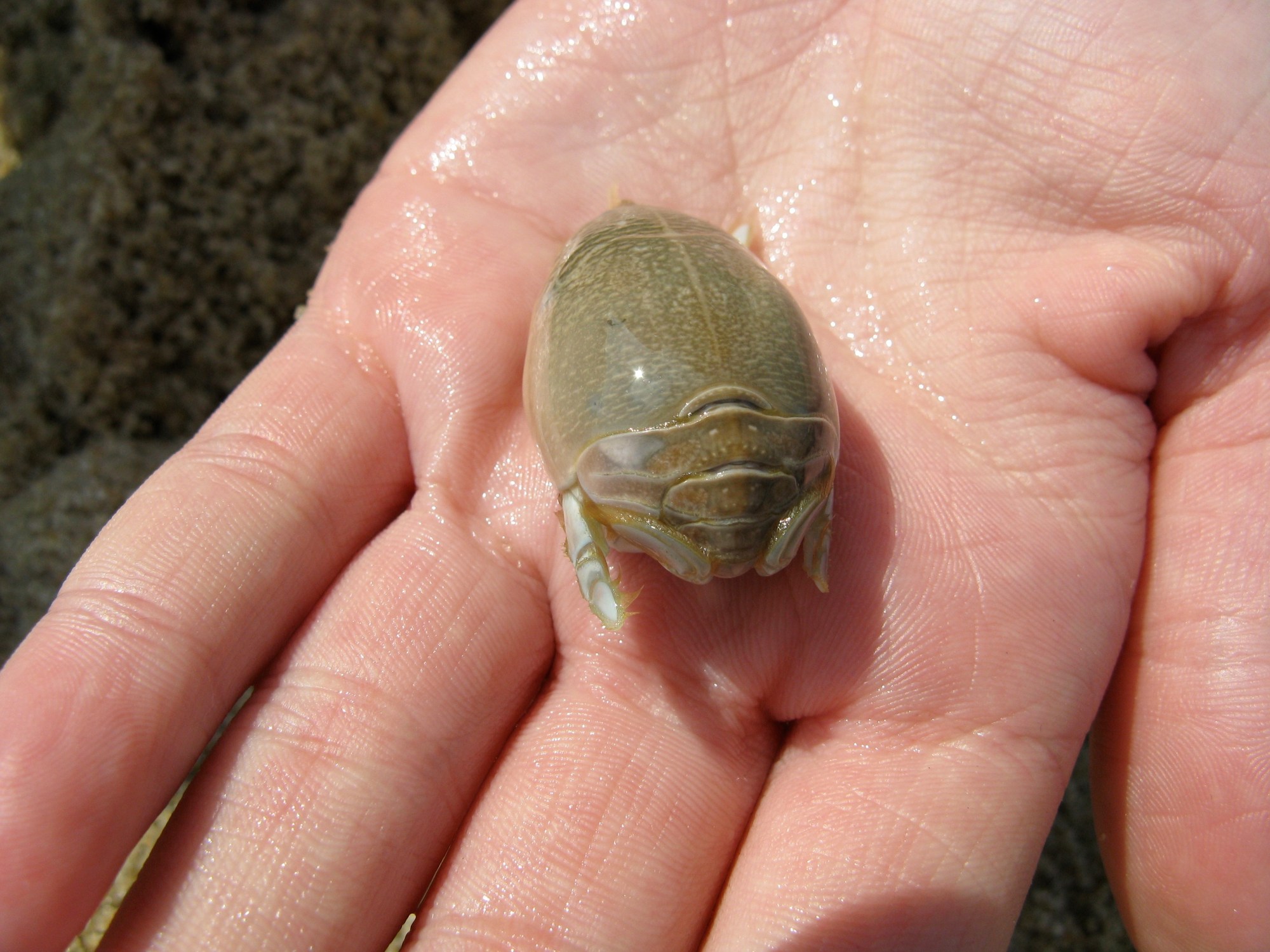
This is one of my favorite New Jersey, Naturally columns that was published in the Star-Ledger in 2008. Not only did I spend a summer day at Manasquan beach with my daughter for research purposes, but I was also able to declare the cost of a beach badge as a business expense on my tax returns.
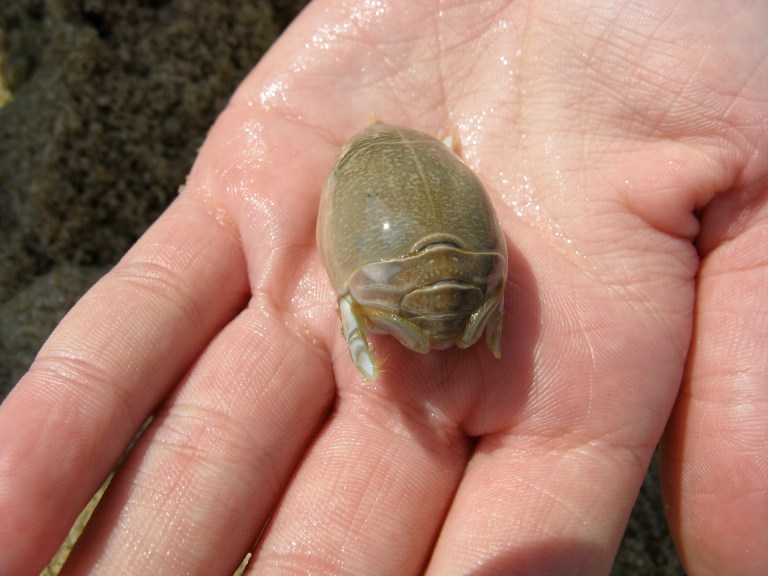
What kind of crab is this anyway?
It is one of the oddest creatures you’ll find at the New Jersey shore in the summer, and I don’t mean that pale-skinned hairy guy in the Speedo.
If you’ve spent any time at all near the shoreline itself, you’ve probably seen one. You may even have picked one up and felt its five pairs of legs tickle your palm in its futile attempt to bury itself in your skin. You may have felt one without realizing it, when a wave receded and the sand beneath your foot seemed to collapse a little more than it should have.
It’s found on every sandy saltwater beach in New Jersey, yet very few people know its real name. In a recent informal survey I conducted at Manasquan beach, not one of the 20 people who viewed the creature could properly identify it.
(Note to any male considering walking along a crowded New Jersey shoreline in just swim trunks and asking fellow beachgoers to look at something: You’ll get more positive, upbeat responses if you have a kid hold the object in question for you.)
Five of the 20 people had absolutely no idea what it was. A glance, a shrug, an “I dunno,” and back to the book or newspaper.
Thirteen of them called it a sand crab—the common term for the creature, but technically incorrect.
Two called it a hermit crab. (I think they were New Yorkers.) Oddly, no one called it a sand flea, which is another common misnomer.

The creature is properly called a mole crab, which refers to its incredible ability to continually bury itself in the sand after an incoming or receding wave washes it out of its place. They are beige or tan—essentially the color of sand—and 1/2 to 1 inch in diameter (the females are larger). They range from Massachusetts to the Gulf of Mexico, making their home in the sand in shallow water during warm weather, moving to deeper water in winter. Beachgoers typically encounter them in the wet sand between the high and low tide lines.
A mole crab feeds by poking its two feathery antennas out of the sand while the rest of the crab remains buried in it. When waves smash the beach, the antennas catch “organic detritus and plankton” being washed around, says Michael J. Kennish, associate research professor at Rutgers University’s Institute of Marine and Coastal Sciences. That’s another name for the stuff you try to not think about when you accidentally swallow a mouthful of seawater.
Mole crabs are unique, points out Kennish, because they are virtually the only crab that moves backward. (Blue crabs, the crustacean that New Jerseyans are more familiar with, move sideways.) And when mole crabs position themselves in the sand, they’re always facing the ocean so they can raise those antennas and catch food. They’ll burrow all the way down under the surface to hide from predators such as shorebirds.
Short of watching sea gulls that sneak over to eat someone else’s French fries, mole crabs are also one of the most entertaining and useful living things on the beach. They can:
—Keep kids happy and busy. Because mole crabs bury themselves in the sand at the waterline, kids can prospect for them with shovels or just their hands. The crabs can be kept alive in buckets filled with sand and water (temporarily, and in the shade of a beach chair). Mole crabs don’t have claws and can be handled without fear of a pinch. But their shell is thin so they shouldn’t be handled roughly.
—Amuse adults. Place a live mole crab on the back or belly of your sunbathing spouse, where it will scurry about, trying to hide. Watch the sand fly! Listen to the colorful language!
—Help feed you. Mole crabs are good bait; I once caught a striped bass at Island Beach State Park that had eight large whole mole crabs in its belly.
According to Kennish, mole crab numbers are actually increasing in some areas, but that, he says, is probably caused by an increase in ocean water temperature. Otherwise, mole crabs seem to get by all right with us around.
In fact, if they would develop a taste for cigarette butts and tampon applicators, mole crabs would be the perfect New Jersey sea creatures.
 miketoth.net