
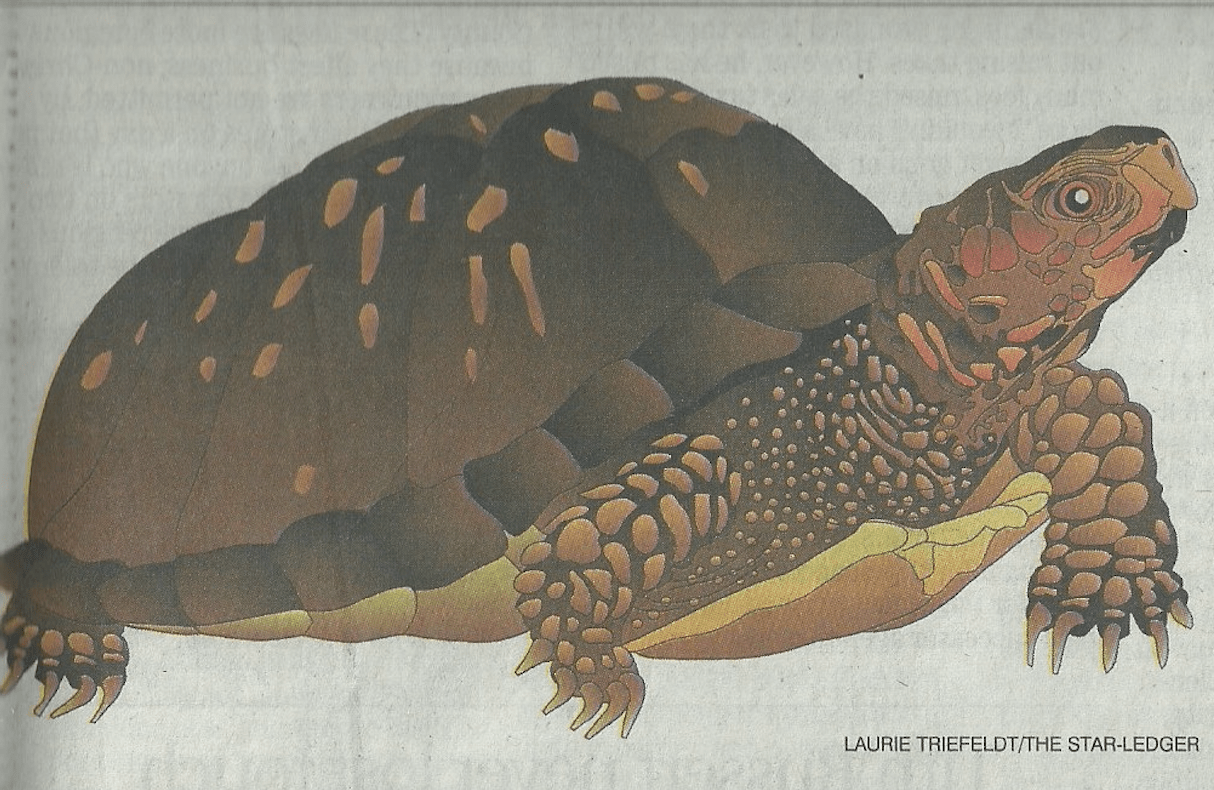
This was one of my New Jersey, Naturally columns published in the Star-Ledger, and the Penn Stater Magazine reprinted the story in a 2008 issue. Since writing it I’ve come across several box turtles in my neighborhood and around town, all crossing a road. I take the time to stop and carry them to the side that they’re heading for, out of traffic.
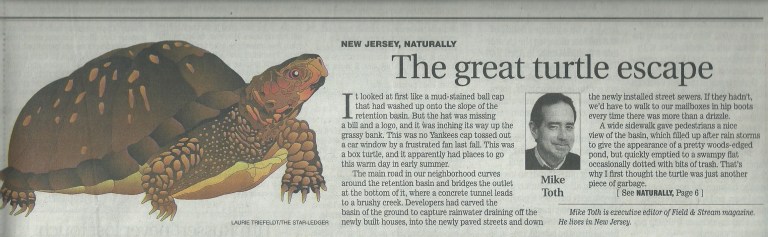
It looked at first like a mud-stained ball cap that had washed up onto the slope of the retention basin.
But the hat was missing a bill and a logo, and it was inching its way up the grassy bank. This was no Yankees hat tossed out a car window by a frustrated fan last fall. This was a box turtle, and it apparently had places to go this warm day in summer.
The main road in our neighborhood curves around the retention basin and bridges the outlet at the bottom of it, where a concrete tunnel leads to a brushy creek. Developers had carved the basin out of the ground to capture rainwater draining off of the newly built homes, into the newly paved streets and down the newly installed sewers. If they hadn’t, we’d have to walk our mailboxes in hip boots every time there was more than a drizzle.
A wide sidewalk gave pedestrians a nice view of the basin, which filled up with water after rainstorms to give the appearance of a pretty woods-edged pond, but quickly emptied to a swampy flat occasionally dotted with bits of trash. That’s why I first thought the turtle was just another piece of garbage.
I walked over to the slowly plodding creature. I knew it wasn’t a dangerous snapping turtle, as it didn’t have an overly large head and long tail. When I placed a foot in front of the turtle, it immediately retracted its head and legs into the high-domed, brown and yellow shell. I picked the turtle up and turned it over. The yellowish bottom, drawn up tightly against the shell edge, was surprisingly scarred and worn. It seemed old.
I carried the turtle back to the house to show the kids. (Full disclosure here: Keeping a turtle in captivity is against the law in New Jersey.) My daughter, who feels compelled to give a proper name to anything with a face, ran her hand over the top of the shell, feeling the symmetrical ridges. “Buttons!” Carrie exclaimed. “Can we keep it?”
“For a while,” I said. “Let’s put it in the garden.” I’d surrounded our young tomato and pepper plants with three-foot-high mesh fencing to keep the rabbits out, so it would make a suitable temporary home.
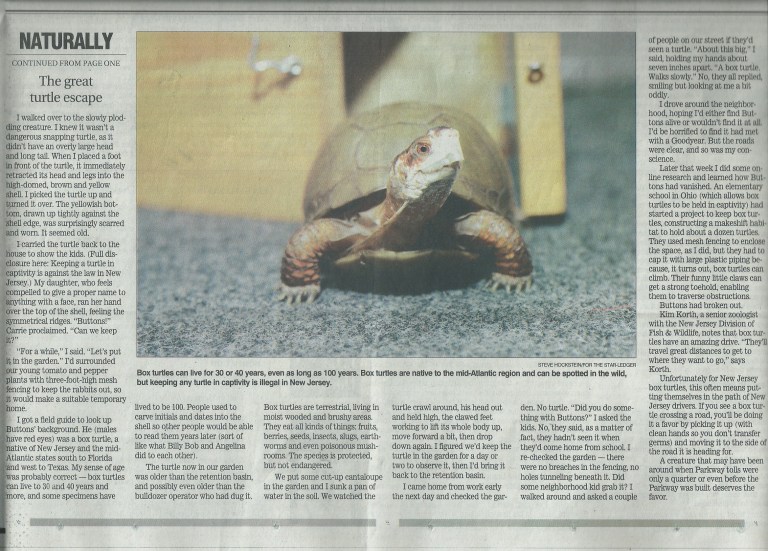
I got a field guide to look up Buttons’ background. He (male turtles have red eyes) was a box turtle, a native of New Jersey and the mid-Atlantic states south to Florida and west to Texas. My sense of age was probably correct—box turtles can live to 30 and 40 years and more, and some specimens have lived to be 100. People used to carve initials and dates into the shell so other people would be able to read them years later (sort of like what Billy Bob and Angelina did to each other).
The turtle now in our garden was older than the retention basin, and possibly even older than the bulldozer operator who had dug it.
Box turtles are terrestrial, living in moist wooded and brushy areas. They eat all kinds of things: fruits, berries, seeds, insects, slugs, earthworms and even poisonous mushrooms. The species is protected, but not endangered.
We put some cut-up cantaloupe in the garden and I sunk a pan of water in the soil. We watched the turtle crawl around, his head out and held high, the clawed feet working to lift its whole body up, move forward a bit, then drop down again. I figured we’d keep the turtle in the garden for a day or two to observe it, then I’d bring it back to the retention basin.
I came home from work early the next day and checked the garden. No turtle. “Did you do something with Buttons?” I asked the kids. No, they said; as a matter of fact, they hadn’t seen it when they’d come home from school. I re-checked the garden—there were no breaches in the fencing, no holes tunneling beneath it. Did some neighborhood kid grab it? I walked around and asked a couple of people on our street if they’d seen a turtle. “About this big,” I said, holding my hands about seven inches apart. “A box turtle. Walks slowly.” No, they all replied, smiling but looking at me a bit oddly.
I drove around the neighborhood, hoping I’d either find Buttons alive or wouldn’t find it at all. I’d be horrified to find it had met with a Goodyear. But the roads were clear, and so was my conscience.
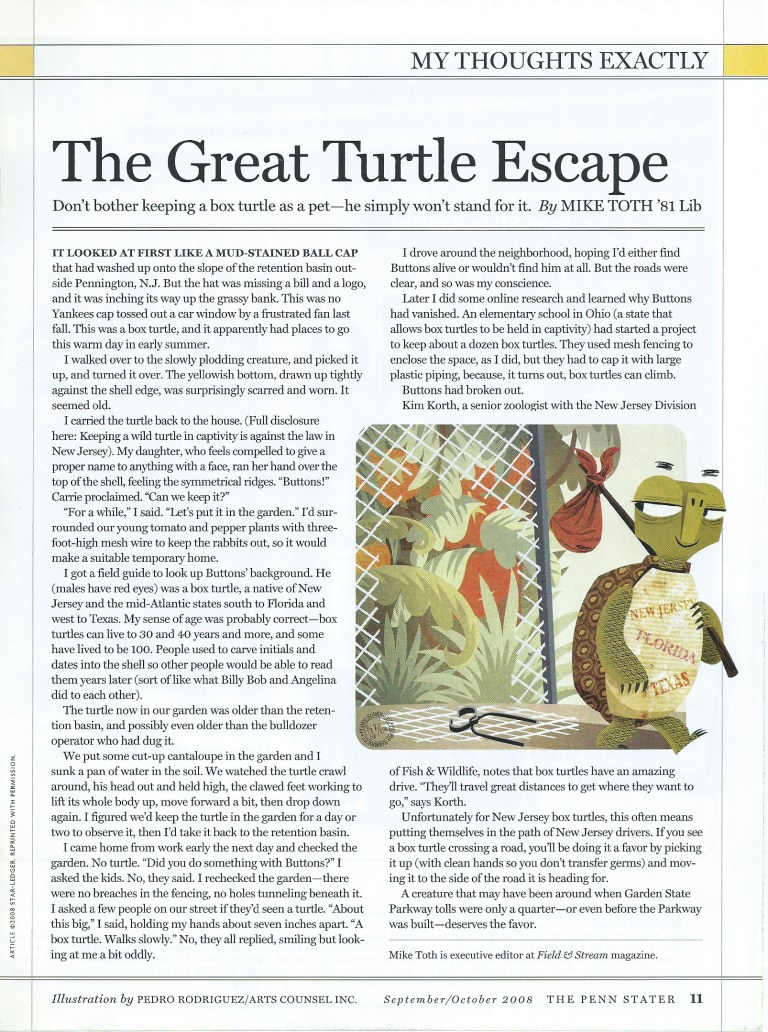
Later that week I did some online research and learned how Buttons had vanished. An elementary school in Ohio (which allows box turtles to be kept in captivity) had started a project to keep box turtles, constructing a makeshift habitat to hold about a dozen turtles. They used mesh fencing to enclose the space, as I did, but they had to cap it with large plastic piping because, as it turns out, box turtles can climb. Their funny little claws can get a strong toehold, enabling them to traverse obstructions.
Buttons had broken out.
Kim Korth, a senior zoologist with the New Jersey Division of Fish & Wildlife, notes that box turtles have an amazing drive. “They’ll travel great distances to get where the want to go,” says Korth.
Unfortunately for New Jersey box turtles, this often means putting themselves in the path of New Jersey drivers. If you see a box turtle crossing the road, you’ll be doing it a favor by picking it up (with clean hands so you don’t transfer germs) and moving it to the side of the road it is heading for.
A creature that may have been around when Garden State Parkway tolls were only a quarter, or even before the Parkway was built, deserves the favor.
 miketoth.net