
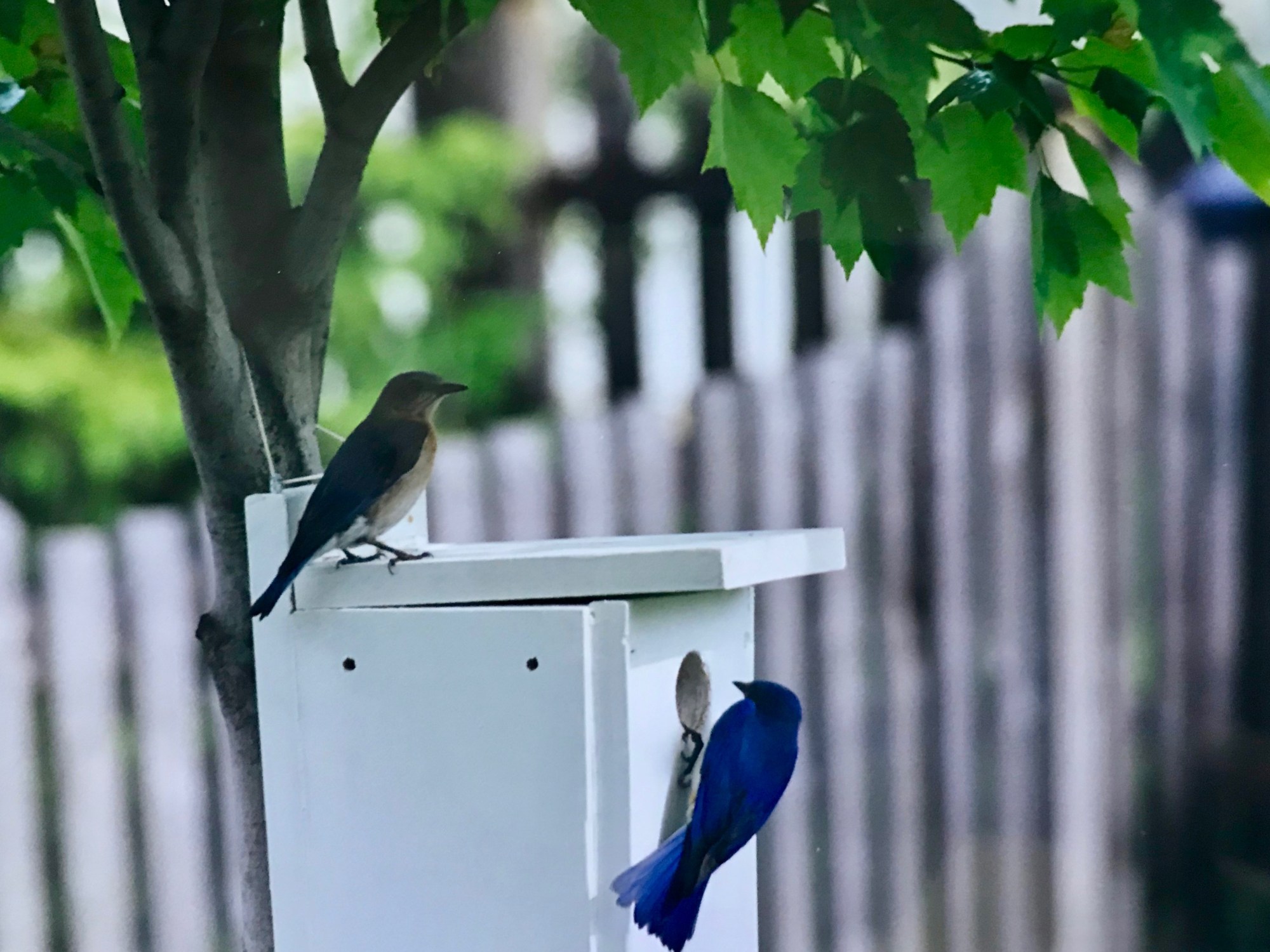
This story, about a pair of bluebirds that showed up at a little home-made nesting box in our small suburban backyard, originally ran in New Jersey Monthly magazine. It was delightful but very surprising, because bluebirds prefer wide open spaces to forage and nest. We had bluebirds return to the box for several years after this first pair showed up, until our yard became too overgrown. But we still have bluebirds visit in winter, feeding on holly berries along the side of the house, which is a beautiful sight in a snowy winter landscape.
The male, with its cobalt back and tail feathers, showed up first.
It perched on the roof of the new birdhouse outside our family-room window in the spring, hopping and twittering as if it has just signed a 30-year mortgage for the structure: anxious about the commitment, but pleased to have a new home. A few minutes later, his intended peered down from the top branch of a young pin oak nearby and warbled her interest, if not her approval.
The nesting box must have passed the female’s wall-eyed inspection, though, because a few weeks later, five tiny azure eggs lay nestled in the circular, dimpled mound of brown grass that the bluebirds had built inside. But the miracle of nature was not that the bluebirds had courted, mated, and reproduced.
The miracle was that the bluebirds had shown up at all.
Three years earlier, on an autumn afternoon walk near our house through fallow fields marked ominously by lot stakes and surveyor’s tape, my wife, children, and I noticed a flock of six small birds jumping and flitting ahead of us like bits of windblown denim. I recognized them as bluebirds, searching for their fall diet of grasshoppers, crickets, and spiders. The designated naturalist of the family, I pointed out that these large, uncultivated fields edging onto woods provide excellent bluebird habitat and that the “luxury townhomes,” which would soon be erupting out of the ground we were standing on, would destroy it. The bluebirds, I said, would disappear.
Bluebirds like open spaces, where they can hunt for soft-bodied bugs in spring, near woods where they can nest in tree cavities. Because comparatively few dead standing trees are left in the modern, heavily timbered forests of the United States—and because other species of birds compete for those nesting sites, particularly the house sparrow, which was inadvertently introduced to this country from Europe in the 1800s—bluebirds are not all that common. In fact, the species has survived in fair numbers largely because of human intervention, in the form of bluebird nesting boxes. Across the country, thousands of bluebird fans have erected these simple “birdhouses” on trees, fence posts, and poles in fields and clearings. In New Jersey, bluebirds aren’t rare, exactly, just rarely seen.
Bluebird experts recommend that the boxes be erected wherever proper habitat and forage abound—in other words, in large, weedy fields with lots of bugs. So when my son and I built our nesting box, with its skewed roof, hairline splits, and runny paint, and hung it on the skinny maple next to our patio in early spring, all I was expecting to inhabit it was wrens.
After all, we live in a five-year-old house on a lot smaller than a fifth of an acre. We’re surrounded by houses and lots of similar age and scale, all part of a typical mega-development in a once pastoral section of Mercer County. This is the land of two-car garages, no-maintenance vinyl siding, and hyper-fertilized lawns. The trunk on the biggest tree in the neighborhood is no bigger around than my six-year-old daughter’s leg. Bluebird hell. Bedroom-community bliss.
But that is not to imply that we live in a suburban utopia. Far from it: Our house, though relatively new, isn’t spacious and can feel cramped, especially when winter locks the four of us inside. Shoddy workmanship, evident in the foul sewer odor emanating from the shower drain, would cost too much to fix. Uneven heating and cooling leaves us alternately sweating and shivering at all times of the year. The short distances between houses enable us to hear our neighbors, and sometimes see them, during what should be their most private moments (Taking a shower, Claire!”). The lot is too small: We planted evergreen trees and bushes around the backyard border just so we can grill a few burgers on the patio and throw a ball to the kids without feeling like a closely scrutinized family of, well, birds in a nesting box.
After we hung our bluebird box, the four of us spent a lot of time with our noses pressed against the window behind the TV, watching the bluebirds gather grass and straw for their nest, ward off other small birds that were interested in brooding there, and gathering food for their nestlings from sunrise to sunset. Occasionally, when both the male and female were out of sight, we’d dart out the back door and lift the roof of the box to examine the nest, the eggs, and later, the nestlings. One evening the four of us sat silent and almost motionless on the patio as the female, after eying us for what seemed like an hour, flew down from the box to gather some mealworms—prime bluebird food—that we had placed on the ground just a few feet away from us.
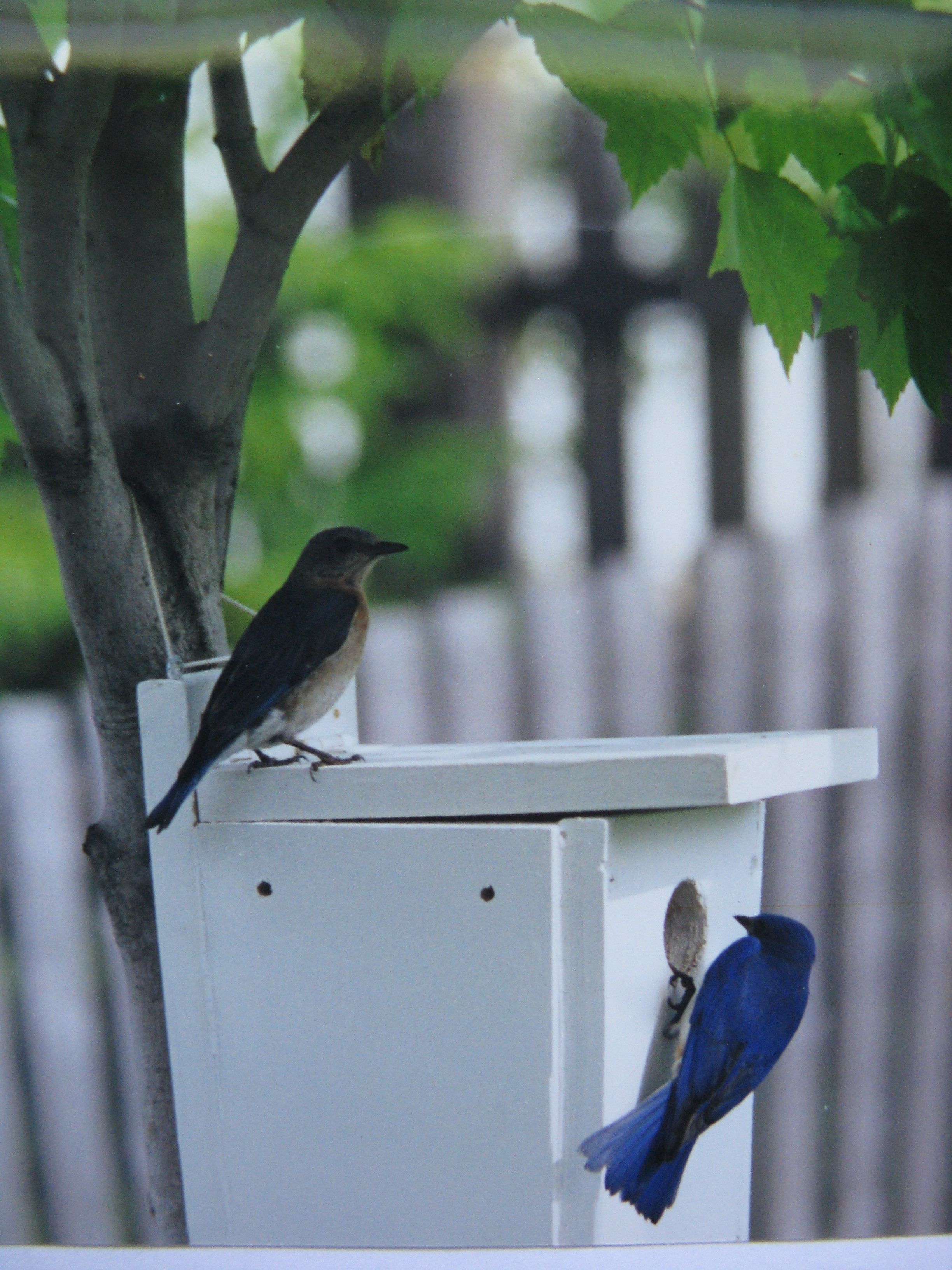
One bluebird would often stand watch as the other would attend to the nest or feed the nestlings. Here, the female adopts a position on top of the box as the male prepares to enter it.
The children became the keepers of the box. They would be careful to kick balls and throw the Frisbee on the side of the house away from the nest. Their friends would come over on play dates and ask to peek inside the bluebird house. Crayoned murals of oversized bluebirds were hung by magnets on the refrigerator.
Then one day soon after the nestlings hatched, my daughter told me that she had seen some big black birds flying and fluttering near the box while the parent bluebirds were gone. When we went outside and looked in the box, only one nestling was inside. Then Caroline yelled “Dad!” and pointed to the ground. Not an inch from my foot was another nestling, apparently dropped by one of the crows when they attacked the nest—to feed their own babies, I gently explained. We placed the lost nestling back in the box. It thrived, as did its sibling.
And then one day they were gone. I had known that the two young birds were close to being fledged—they were nearly fully feathered—but it had happened when we were away from home.
The bluebirds’ temporary home again became nothing but a crookedly built white box hanging from a thin tree. Yet those little birds did more than provide a backyard diversion. Although I’ve dropped more than a fair share of cash at the Home Depot, the bluebirds taught me that it’s not the quality or the model or the location of the house, but what the house represents that is most important to raising a family. Our children don’t know or care about cheap driveway sealant or thin carpet padding. And they shouldn’t. This is their life base, their place of security, sanctuary and love, their nesting box. Sure, I wish I had a basement and a bigger yard, among many other amenities, but those comforts are no substitute for the caring, unity, and belonging that really constitute the foundation of our home.
So I’m reassured that when the time comes for my wife and me to push our children out of our imperfect nest, they’ll be prepared to find all the bugs and berries they need in life, no matter where they go.
And maybe, along the way, they’ll put up a bluebird box.
black-walnuts black-walnuts-new-jersey bluebirds books box turtle Cajun Fishing Adventures dogs editor field & stream fishing Fish N Fillet Florida Keys fishing Florida Keys kayak Florida Keys kayak fishing fluke foraging how to eat tomatoes jaws jersey-tomatoes Jersey shore Keys kayak fishing labradoodles Lawrence Hopewell Trail LHT Mike Toth Mole crab movies new-jersey-tomatoes New Jersey New York City pennington Penn State peter-benchley pets putting-a-dog-to-sleep Rapala knife Redfish sand crab sand flea sea trout squirrels steven-spielberg summer flounder tomatoes woodcock
 miketoth.net