

This was a New Jersey, Naturally column that many people told me they related to, often quite vociferously and with more than a few profanities.
It started around Memorial Day weekend as a fun family moment, when we gathered at a window to watch a cute furry animal hopping around, nibbling on grass in our backyard.
By Labor Day weekend it had become a grim war of aggression on a ruinous beast in an effort to return happiness and harmony to our household.
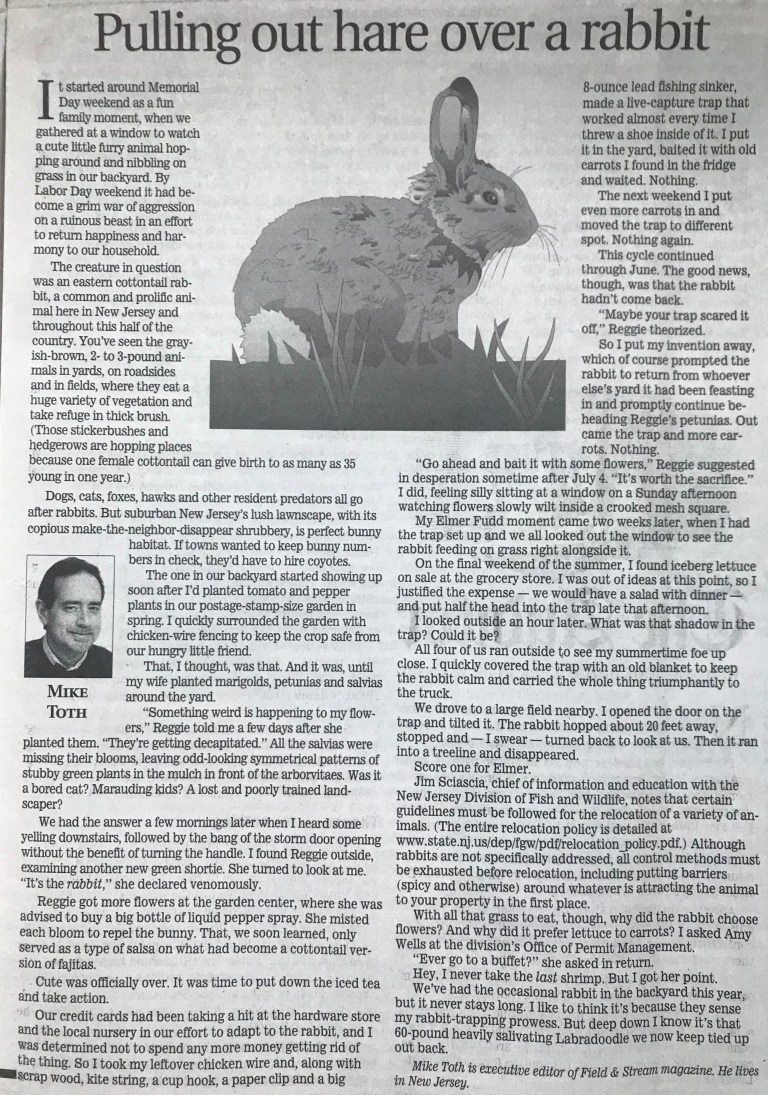
The creature in question was an eastern cottontail rabbit, a common and prolific animal here in New Jersey and throughout this half of the country. You’ve seen the grayish-brown, 2- to 3-pound animals in yards, on roadsides and in fields, where they eat a lot of vegetation and take refuge in thick brush. (Those stickerbushes and hedgerows are hopping places, because one female cottontail can give birth to as many as 35 young in one year.)
Dogs, cats, foxes, hawks, and other resident predators all go after rabbits. But suburban New Jersey, with its make-the-neighbor-disappear shrubbery, is perfect bunny habitat. If towns wanted to keep rabbit numbers in check, they’d have to hire coyotes.
The one in our backyard started showing up soon after I’d planted tomato and pepper plants in our postage-stamp-size garden in spring. I quickly surrounded the garden with chicken-wire fencing to keep the crop safe from our hungry little friend.
That, I thought, was that. And it was, until my wife planted marigolds, petunias and salvias around the yard.
“Something weird is happening to my flowers,” Reggie told me a few days after she planted them. “They’re getting decapitated.” All the salvias were missing their blooms, leaving odd-looking symmetrical patterns of stubby green plants in the mulch in front of the arborvitaes. Was it a bored cat? Marauding kids? A lost and poorly trained landscaper?
We had the answer a few mornings later when I heard some yelling downstairs, followed by the bang of the storm door opening without the benefit of turning the handle. I found Reggie outside, examining another new green shortie. “It’s the rabbit,” she declared venomously.
Reggie got more flowers at the garden center, where she was advised to buy a big bottle of liquid pepper spray. She misted each bloom to repel the bunny. That, we soon learned, only served as a type of salsa on what had become a cottontail version of fajitas.
Cute was officially over. It was time to put down the iced tea and take action.
Our credit cards had been taking a hit at the hardware store and the local nursery in our effort to adapt to the rabbit, and I was determined not to spend any more money getting rid of the thing. So I took my leftover chicken wire and, along with scrap wood, kite string, a cup hook, a paper clip and a big 8-ounce lead fishing sinker, made a live-capture trap that worked almost every time I threw a shoe inside of it. I put it in the yard, baited it with old carrots I found in the fridge, and waited. Nothing.
The next weekend I put even more carrots in and moved the trap to a different spot. Nothing again.
This cycle continued through June. The good news, though, was that the rabbit hadn’t come back.
“Maybe your trap scared it off,” Reggie theorized.
So I put my invention away, with of course prompted the rabbit to return from whoever else’s yard it had been feasting in and promptly continue beheading Reggie’s petunias. Out came the trap and more carrots. Nothing.
Go ahead and bait it with some some flowers,” Reggie suggested in desperation sometime after July 4. “It’s worth the sacrifice.” I did, feeling silly sitting at a window on a Sunday afternoon watching flowers slowly wilt inside of a crooked mesh square.
My Elmer Fudd moment came two weeks later, when I had the trap set up and we all looked out the window to see the rabbit feeding on grass right alongside it.
On the final weekend of the summer, I found iceberg lettuce on sale at the grocery store. I was out of ideas at this point, so I justified the expense–we would have a salad with dinner—and put half the head into the trap late that afternoon.
I looked outside an hour later. What was that shadow in the trap? Could it be?
Reggie and the kids and I ran outside to see my summertime foe up close. I quickly covered the trap with an old blanket to keep the rabbit calm, and carried the whole thing triumphantly to the truck.
We drove to a large field nearby. I opened the door on the trap and tilted it. The rabbit hopped about 20 feet way, stopped and—I swear—turned back to look at us. Then it ran into a treeline and disappeared.
Score one for Elmer.
Jim Sciascia, chief of information and education with the New Jersey Division of Fish & Wildlife, notes that certain guidelines must be followed for the relocation of a variety of animals. (The entire relocation policy is detailed here.) Although rabbits are not specifically addressed, all control methods must be exhausted before relocation, including putting barriers (spicy and otherwise) around whatever is attracting the animal to your property in the first place.
With all that grass to eat, though, why did the rabbit choose flowers? And why did it prefer lettuce to carrots? I asked Amy Wells at the division’s Office of Permit Management.
“Ever go to a buffet?” she asked in return.
Hey, I never take the last shrimp. But I got her point.
We’ve had the occasional rabbit in the backyard this year, but it never stays long. I like to think it’s because they sense my rabbit-trapping prowess. But deep down I know it’s that 80-pound heavily salivating Labradoodle we now keep tied up out back.
 miketoth.net