
 This story ran in the Wall Street Journal in August 2019, and the assignment gave me an excuse to attend the ICAST (International Convention of Allied Sportfishing Trades) Show in Orlando. ICAST is the world’s biggest fishing trade show, and a lot of fun to attend. You can cast lures in the giant lure tank, handle thousands of fishing rods, check out the latest electronics, sit in new boats and kayaks…all in the name of business. Fortunately for me, my son Joe loves to fish (that’s him above, with a nice Barnegat Bay fluke), but as I learned, young anglers aren’t as prevalent as they have been.
Paul Harris remembers going fishing with his father in a Ford Model A at the New Jersey shore.
“Back in the 1940s, we’d go to the old Phipps estate for the weekend and fish for kingfish and croakers. Then we’d drive back home to Philadelphia, where the mothers and grandmothers were all waiting for the fish,” says Harris, 75, who still fishes that 10-mile stretch of shoreline now known as Island Beach State Park.
Harris taught his two daughters to fish on that beach in the 1970s (both still actively fish on their own), and has fond memories of those times. “We were a crowd. Whole families would drive onto the sand and fish together. The older kids would help keep an eye on the younger kids. Now, you look up and down the beach, you see very few families fishing. You can’t get the kids outside anymore.”
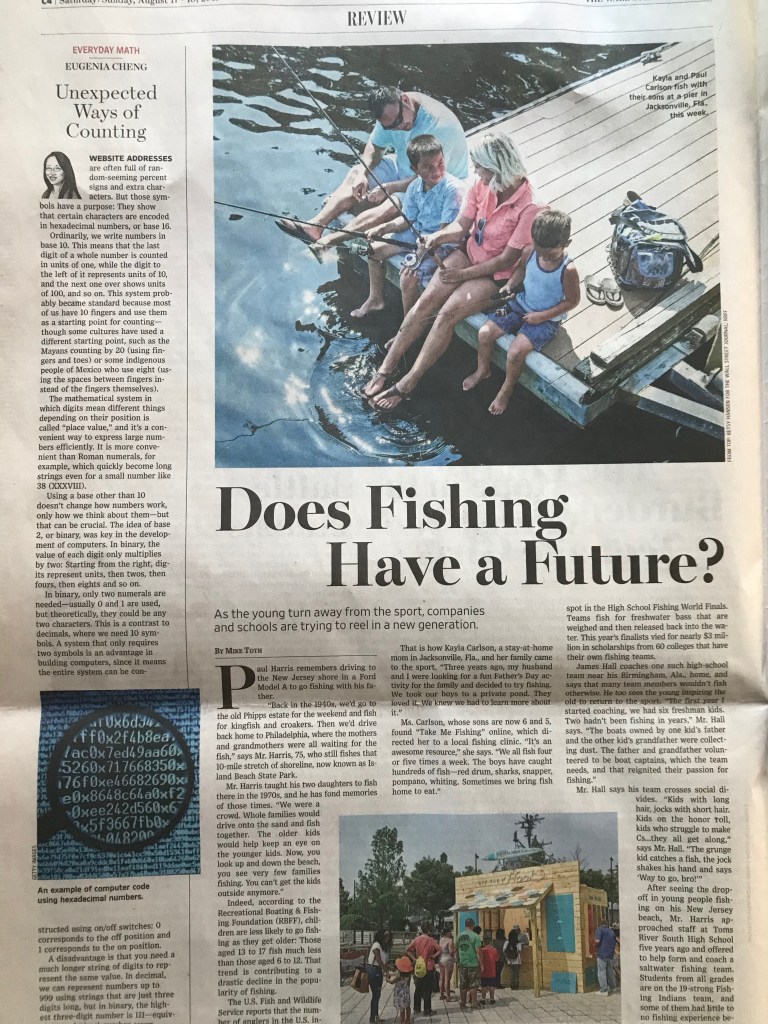
Indeed, surveys indicate a nationwide drop-off in fishing activity. The U.S. Fish & Wildlife Service reports that the number of total anglers in the U.S. increased from 33.1 million in 2011 to 35.8 million in 2016. But the number of total days they fished dropped precipitously—from 553.8 million to 459.3 million, a 17 percent decrease. That’s 94.5 million fewer days fished.
Opinions vary on what has caused the reduction, but no one disagrees that the historical model of creating lifelong anglers—a parent teaching a child to fish, and that child growing up and teaching his or her kids to fish—has morphed, and is affecting participation. Many kids who fished with a parent when young don’t continue when they’re older. According to the Recreational Boating & Fishing Foundation (RBFF), which leads the fishing industry’s drive to increase participation, children ages 13 to 17 fish much less than kids ages 6 to 12.
What is keeping older kids off the water?
(Read the rest at wsj.com.)
 miketoth.net