
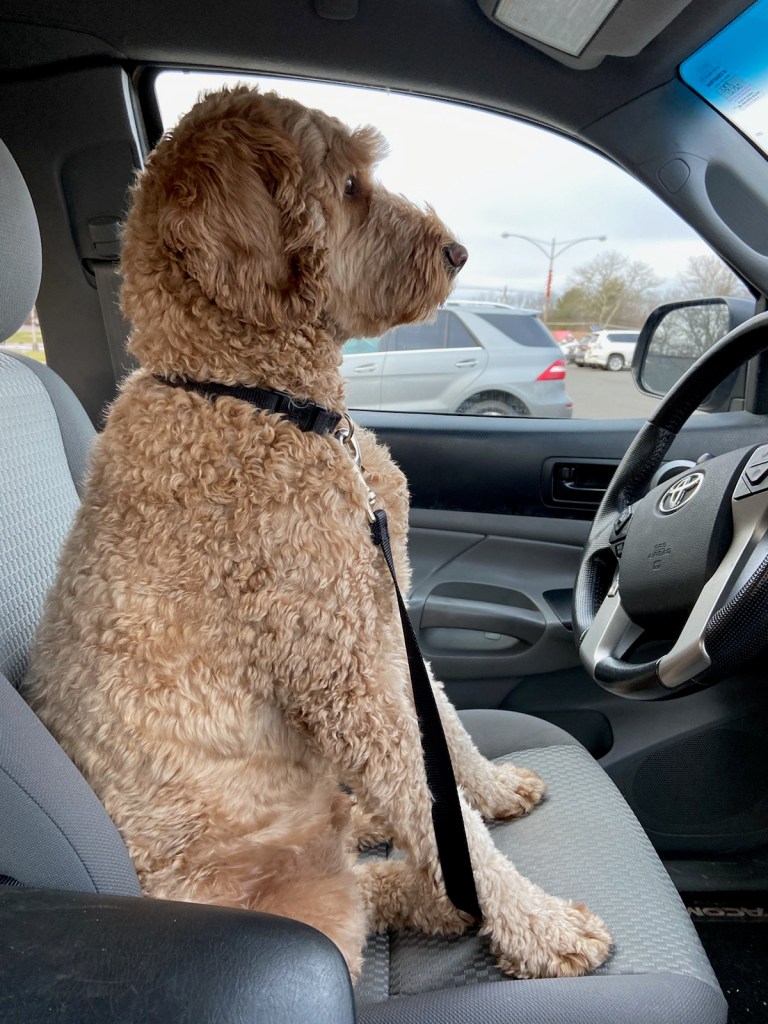
I hope this story helps people understand not just the process of putting a dog to sleep, but also the difficulty and self-doubt that comes with making such a decision. And, that they’re not alone in their confusion and grief. This photo of Captain, taken by my wife when I had to run into a store for something, is one of my favorites. Cap had the habit of jumping into the driver’s seat whenever I left the car, intently watching for me to return.
© 2025 Mike Toth
I first noticed the lumps on Captain’s neck in early July. He’d come to sit next to me for his usual morning pet, his daily habit as soon as I sat down with my first cup of coffee. He’d stare at me until I put down my mug and massage his cheeks, his ears, the back of his neck. That morning, Cap lifted his head for a throat rub and I felt twin protrusions on either side of his esophagus. I thought they were his tonsils (did dogs have tonsils? I reminded myself to check). I hadn’t noticed them before, but Cap looked fine and had been acting totally normally. Mostly.
His eyes seemed to be a bit smaller than they had been, as if he was slightly squinting.
He hadn’t been showing as much interest in his food as usual. Cap used to scarf down his breakfast so fast that sometimes a whole kibble would occasionally get lodged in his throat, and he’d have to cough it out. But he’d begun leaving his breakfast alone when the summer started, eating it instead at lunchtime. Most of it, anyway. There were always a few kibbles still in the bowl, and I’d add his evening meal (which I’d reduced in size) to the leftovers. Often, he’d finish it all. But not always.
He also seemed to be running hotter than normal, panting more often and seeking out cool floors in the house. And he seemed to lose interest in the throw-and-fetch game sooner than usual.
The behavioral changes could certainly be caused by the heat. It was July and we were having another heat wave. Who has a voracious appetite and wants to chase a toy thrown into bushes on a 90-degree evening? I figured things would go back to normal once the temperatures started moderating.
After all, he was a five-year-old Labradoodle who loved, who lived, to play, run, and eat. He’d had a checkup only four months before and was in perfect health.

This is Cap at the breeder’s house on the day we’d picked him out of the litter. Sometimes a dog chooses you, and that was the case here. As I was yakking away to someone, Cap silently padded over and lay down on my foot.
Still, there was a nagging alarm bell going off in the back of my head. Captain’s slowdown at mealtimes was an unpleasant reminder of Bucky, our first family dog. That giant labradoodle–100 pounds at 4 years, no fat on him at all—had slowly lost about 20 pounds during a battle with cancer that was misdiagnosed by our veterinarian as some sort of lung ailment. He’d stopped eating entirely at the end, and he’d refuse the medication that, it turned out, wasn’t helping at all. Finally a different vet told us that 1) it was cancer, and 2) we should put him down as soon as possible—as in that day. This was at the end of summer, a couple of weeks before our two kids were going off to college—Caroline for her freshman year—and the experience traumatized us all.
My wife, Reggie, googled Cap’s symptoms and found a list of eight reasons that dogs would have lumps on their throat that appear to be swollen tonsils (tonsillitis being one of the causes). Cancer was a possibility too, but what happened to Bucky certainly couldn’t happen to Captain. Even so, that alarm bell got a little louder.
I brought Cap back to our new vet—Dr. Wilson at Lawrence Animal Hospital in New Jersey, an excellent practice. Dr. Wilson felt the lumps at his throat and probed other spots—the top of his chest, under his front and rear legs, his hocks. “Oh,” he said. “Oh.” He slid down onto the floor while keeping a hand on Captain. “It’s lymphoma. Stage 3A, meaning non-symptomatic. All but one of his lymph nodes are swollen.”
A gut punch. I dropped down to Cap and put my hand on his head. I literally couldn’t believe it. I felt tears start at the corners of my eyes. I was 65, have had dogs all my life, and I felt like I was 12 years old. “What?” I said. “How can that be? He was fine in March when he had his annual checkup. He’s five years old. How could he get cancer so quickly?”
Dr. Wilson explained that dogs, unlike people, can develop lymphoma rapidly, that he had examined a dog that was only a year old that had developed lymphoma, that no one is sure of the causes, but that it seems prevalent in goldendoodles (Cap was a Labradoodle, but tawny-blond in color—called apricot in the dog world).
“How much longer does he have?” I heard the words come out of my mouth, but they didn’t sound like mine.
“With steroid treatment, which often brings about a remission, he could have three to six months. With chemotherapy, maybe six months to a year.”
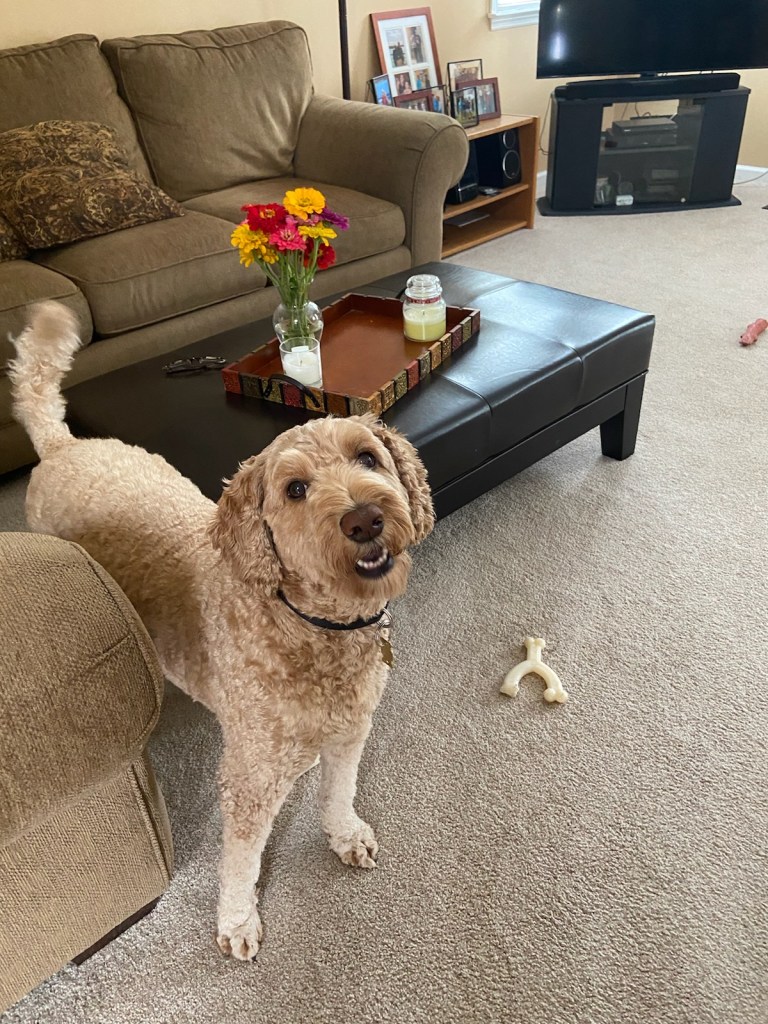
Here’s Cap in the family room, tail aswish as usual, wondering why I’m playing with that boring little box again instead of picking up his chew toy and throwing it across the room.
I looked at Cap, who was panting, and could not believe that this happy, seemingly healthy, tremendously active—I took him on a 1.5-mile walk every morning—super-smart dog of ours, perfectly healthy four months ago, would be gone in a short time. More tears came. I took him home, cried some more, and called Reg. Through tears we both asked ourselves how this could happen. Again.
* * *
Reg wanted to explore the chemotherapy option, so in mid-July we took Captain to NorthStar Vets, an animal hospital recommended by Dr. Wilson that specializes in advanced medical treatment for pets, including oncology. Dr. Sanchez told us it was large-cell lymphoma, which is the worst kind. Chemotherapy would involve bringing Cap there once a week for 16 weeks for the intravenous therapy. He would possibly have to be anesthetized each time. And there would be no guarantee that the treatment would be effective.
The internet is full of information about canine chemo treatment, much of it positive. However, the language is always qualified—“Chemo can help your dog enjoy many more months,” for example—and the side effects include lethargy, nausea, and vomiting. Also, the dog’s urine and stool is toxic for several days after chemo administration. You need to use latex gloves to pick up poop. That was not a problem, but our two-year-old grandchild and six-month-pregnant daughter-in-law not being able to visit for four months certainly was.
We had known of, and had heard about, several dogs that had undergone chemo, and none of them had survived longer than three months. That made us pause. And did we want to subject Cap to the stress of undergoing weekly intravenous treatments?
I know of people who declined chemotherapy for themselves for these very reasons, opting instead to enjoy the remainder of their lives as much as possible. Reg also pointed out that Cap had a sensitive enough stomach as it was—if he ate a blade of grass or a dropped ice cube soon after eating a meal, he’d vomit up everything—and giving him chemo would almost certainly make him sick to his stomach.
We decided to take the steroid route. This at least would give him and us some good last weeks or months with him before he needed to be put down.
* * *
The steroid treatment—20 milligrams of prednisone daily for a week, then a “maintenance” dose of 5 milligrams daily ongoing—had some discomforting side effects. One was increased respiration. Cap had already been panting more heavily and more often because of the lymphoma, and the prednisone ramped that up significantly. Even his normal breathing was accelerated. You could hear him breathing from the next room, even when he was asleep. He began sleeping on the tile floor of a bathroom. Reg got him a gel pad, which is designed to keep a dog comfortable in the heat, and I put it at the foot of the bed. He’d alternate between the pad and the bathroom floor all night.
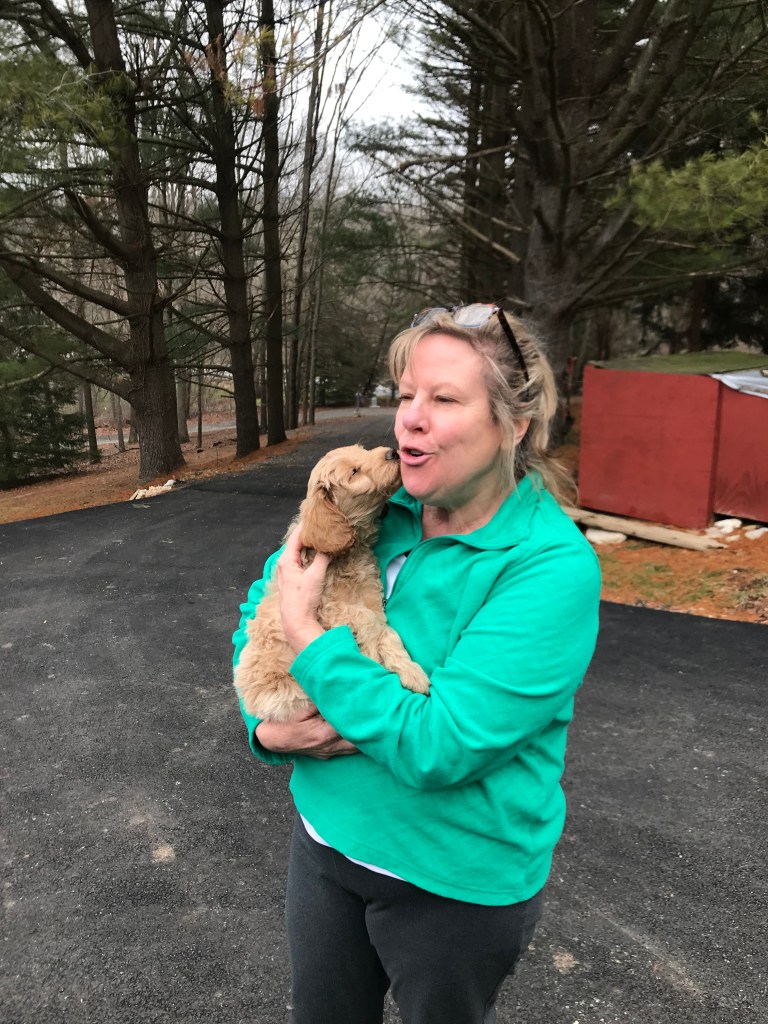
Reg with Cap at the breeder’s house just before the ride to his new home.
His appetite was always very strong, but the prednisone made him ravenous. He began swiping food off of the counter and climbing onto a bathtub surround to get to the garbage can placed out of his normal reach. I quickly began supplementing his twice-daily meals of kibble with a cup of burger and rice. And he got treats all day long. Still, the hunger seemed to be consuming him. Once he even ate the poop of another dog while on a walk—something he’d never done before.
His thirst also created a problem, because he drank so much water that he needed to go outside to pee very often. Cap was totally housebroken—he’d never had even one accident once he learned, as a puppy, that peeing and pooping were things not done indoors—but he was never very good at letting us know when he had to go.
One afternoon in late July he came up to me panting so heavily that I became frightened, wondering if he was going to die right there. I kneeled down and petted him and told him he was a good boy, over and over. Then he walked in the kitchen and let some urine out as he was standing there. I brought him outside immediately and the poor dog peed for what seemed like an entire minute.
He’d been outside to pee not two hours before this happened. That’s how much water he’d been drinking.
That episode made me feel as if I was a terrible, irresponsible dog owner. Yes, I knew the prednisone caused that unrelenting thirst that made him drink so much that his bladder was filling in minutes, but when your dog is extremely uncomfortable because you weren’t paying close attention, you feel awful.
During the rest of July and the first three weeks of August, Captain’s behavior began slowly changing. On our morning walk, he started showing signs of wanting to go back home after a mile. Then after half a mile. Then once he did his business at the end of the street, he wanted to go back home. His interest in playing—fetch, find-the-toy-in-the-bushes, tug-of-war–slowly decreased as well. He began seeking out cold floors during the day. His appetite stayed the same…until one day in late August when he began leaving food in his bowl.
* * *
Throughout this time the reality of needing to put Captain down was always hovering over us. We didn’t talk about it all that much, except to make sure that we were both in agreement on the timing: Not so early that we would be taking good days away from him, and not so late that he would be suffering.
That sounds logical, but following through is extremely difficult. One reason is that you have to decipher exactly how the dog is feeling. That can be difficult to gauge because dogs so often hide their pain (which, I suppose, is probably some atavistic instinct to ensure that the pack won’t abandon you).

Cap in the backseat of my truck after the diagnosis. His drooping eyelids, a symptom of illness, are obvious here—but so is his indomitable good nature.
Another challenge in deciphering the right time to put Cap down was that he was a very happy dog. I’d never had, nor known, a dog with such a pleasant, fun-loving disposition. One of the main reasons we chose him from the litter was his happy inquisitiveness. While at the breeder’s home, trying to choose among the puppies, I dropped keys on the floor and he immediately looked at them, eventually decided they were safe, walked over, smelled the keys, and wagged his tail. An employee at our local pet supply store labeled him “a real wigglebutt of a Labradoodle” on Facebook and put his photo, tail in mid-wag, on her page when he was eight months old. Cap would wag his tail in anticipation of things–when Reg or I first started stirring in the morning, we’d hear the thump-thump-thump of his tail hitting the wall or the dresser. He’d even wag his tail in his sleep. So if the dog is happy, and of course isn’t saddled with the knowledge that it has a fatal disease, what is the right time to end its life?
Dr. Wilson told us that when a dog has lymphoma, it feels discomfort rather than actual pain. “They feel like crap,” he said, “like you would if you’re extremely sick.” This made sense, so Reg and I and made a decision: Once Captain stopped wagging his tail, it would be time to put him down.
Or so we thought.
* * *
Cap’s appetite had decreased, he wasn’t interested in walks, he would only sleep on tile floors, and his panting was getting deeper and faster. Several times a day he’d come up to me with a toy or a tennis ball in his mouth, wagging his tail. I’d throw the toy, he’d walk to it (normally he’d run as fast as he could after it, knocking into walls and furniture) pick it up, take a few steps, drop it, and go lay down on a cool floor.
He still ate, though not as much. Yet our good friends John and Terri gave us a batch of crispy bacon to give to Cap, and we have a video of him rising off of his front feet to get the next piece that Reg was holding out for him, laser-focused on her hand moving into the bag and out of it. It was wonderful to see him so interested in eating, and it was gratifying to see him enjoy something so decadent.
But that was the last time we saw Cap truly interested in something. It was unfathomable that a dog who charged up and down the staircase a dozen or more times a day just to see what was going on in a different room, tail wagging furiously, would fall so hard, so quickly. Reg or I would leave the room where he was, and he’d stay there, flat on the floor, panting. That had never, ever, happened when he was healthy.
This now seemed the time.
It was Tuesday, and Dr. Wilson’s office told me he would be available later in the week.
“I’m thinking Thursday,” I told Reg.
“I was thinking the same thing,” she said. “Let’s have one more day with him.”
The next day I made the call to the vet and set the appointment for 5:30 in the afternoon. I hung up, walked over to where Cap was laying down, bent down and stroked his head. “Best dog ever,” I told him. “Best dog ever.”
* * *
On Wednesday, our friend and neighbor Deepa stopped by with her daughter to say goodbye to Cap. The two of them sat down on the foyer while Cap sidled next to them, put his nose in their hands, and made a half-hearted attempt to hump their legs (his one bad habit that we couldn’t cure). Cap had known Deepa and her family since he was a puppy.
“You know, Cap inspired us to get Boo,” Deepa said. (Boo was their Shih Tzu, and their very first dog.) “We’d see you walking him, and he was always so happy and well behaved.”
I was surprised and flattered. “Well, thank you,” I said. “I only see his faults.”
“What are you going to do with him on his last day?”
“I’ll take him to the tennis courts and look for balls in the grass,” I said. “He loves to hunt for tennis balls that went over the fence. He can smell them from ten feet away.”
The next morning I woke up early and brought Cap outside to pee. There in the early morning light were dozens of tennis balls scattered throughout the front yard—Deepa’s and her daughter’s overnight handiwork. I laughed through tears as Cap walked over to the closest ball, grabbed it, took two steps, then dropped it to grab another. Then he dropped that one to grab another. This went on for about a dozen balls, and Cap walked inside with the last one firmly in his jaws.
The rest of the morning and afternoon went by like a blur. I tried to keep busy with painting and laundry and other household chores, but couldn’t focus on them because I knew that in a few hours this wonderful dog, who had given us so much joy and comfort and steadfast companionship, would be dead.
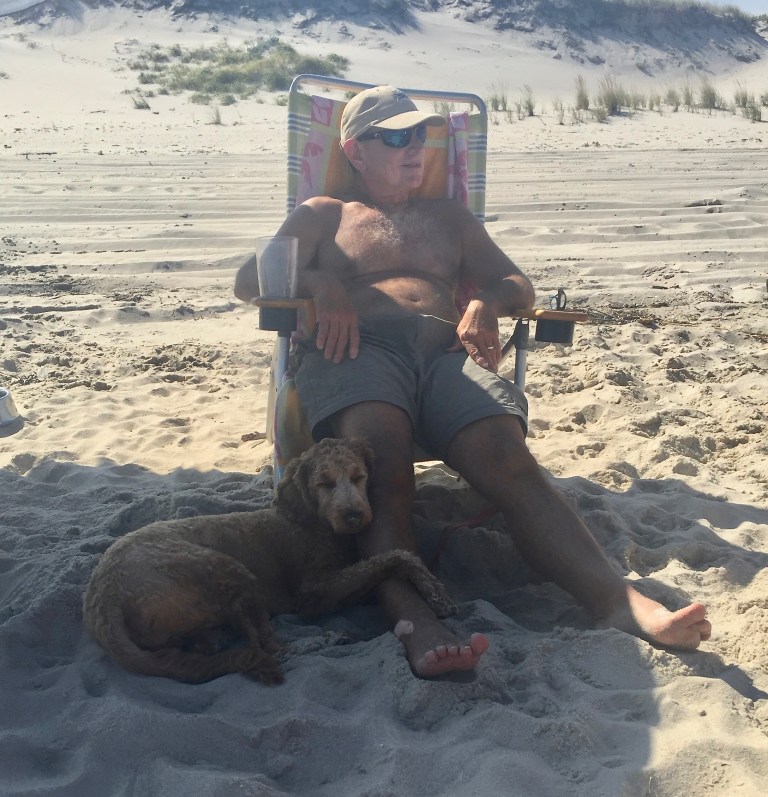
Cap and me on a beach when he was less than two years old. The end of the leash is looped around the back of my beach chair, but obviously I didn’t have to worry about him running off.
Reg came home from work. She’d been crying on the drive home. There was very little to say. I leashed him and we walked outside to my truck, a Toyota Tacoma pickup. Tacomas aren’t very high off the ground, and Cap would always leap right into the backseat. I opened the door and he just stood there looking at the back seat, panting. I picked him up and put him in.
Like many dogs, Cap loved car rides. In the truck he’d always stand with his hind feet on the backseat and his front paws on the armrest, looking out the windshield as if he was in charge of navigating. Before starting to drive I’d have to shoo him back so he wouldn’t come flying forward if I had to come to a sudden stop. This time, he just laid down on the backseat.
Dr. Wilson and his team were waiting for us. Dr Wilson took Cap to insert a port into his leg, explaining that this would simplify the process of administering injections. After a few minutes, he brought him back to the private room where Reg and I were waiting. He injected a solution into the port, explaining to us that this would slow down Cap’s respiration and make him comfortable, and that he’d administer two more shots separately. Dr. Wilson instructed Reg and I to keep our hands on Cap and because he was going to lay down very suddenly after the first shot, which he did. Dr. Wilson left the room to give us some time with Cap, who seemed comfortable on the blanket there. It was a relief that he had stopped panting so hard, but his eyes were half closed.
After a few minutes, Dr. Wilson returned, with two hypodermic needles. He explained that the first one would slow down Cap’s respiration even more, and the second one would eventually stop his heart. We told him to go ahead with the first shot.
I got down on the floor next to Cap as Reg stroked his flank with one hand and wiped away tears with the other. I put my hand close to Cap’s nose so he’d know I was there. Dr. Wilson said he was going to administer the second shot, and we nodded. Cap’s breathing slowed even more, then stopped. Dr. Wilson listened to Cap’s chest with his stethoscope. “He’s gone. I’m sorry.”
A beautiful dog, gone so suddenly, and at such a young age.
We kept our hands on Cap as Dr. Wilson left us alone with him. Reg and I looked at each other and told each other what a wonderful dog he had been, how much pleasure he had brought us, how smart and fun-loving he was, how he had brought all of our family closer.
On the way out of the room I turned and looked back at Captain, my Captain Peanut Toth. He was at rest, but I knew this dog would be at my side the rest of my life.
Good boy, Cap. You’re a good boy!
 miketoth.net