
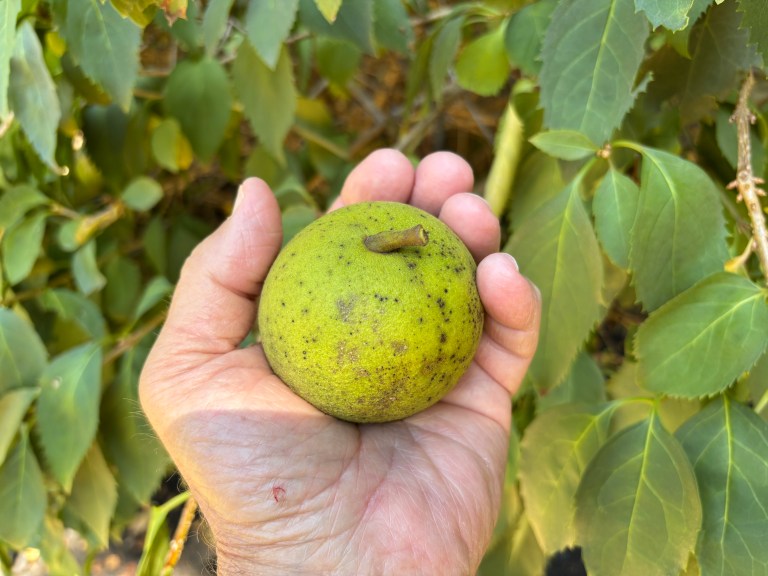
A freshly fallen black walnut. This one is 2 3/4 inches in diameter, an average size in central New Jersey.
I thought it would be a smart way to cut household expenses during these challenging economic times: forage for food in parks and woodlots and along roadsides. In the past month, I’ve come across three black walnut trees, with large, heavy nuts lying right on the ground when I was walking the dog, hunting for squirrels, and watching my kids run in cross-country meets.
I’ve found, however, that there are several downsides to collecting all these tons of free protein just lying around New Jersey every autumn:
- You may wind up with a bunch of maggots squirming around in your pockets.
- Your hands and clothing will become stained a particularly nasty shade of brown, as if you’d just worked your first day at an entry-level job at a sewage treatment plant.
- To open the nuts, you’ll have to forego those nice, cute nutcrackers from Williams-Sonoma. Instead, you’ll need to go to the tool department at Home Depot.
Black walnuts look nothing like those clean, hard attractive English (or “California”) walnuts you buy at the store and put out during the holidays when company comes. In its unprocessed form, the black walnut looks like some vaguely dangerous rotting fruit. That’s because the walnut shell is surrounded by a husk 1 ½ to 2 ½ inches in diameter.
A bunch of freshly fallen walnuts looks like someone dumped a crate of green baseballs beneath a large, black-barked tree. But the husk quickly begins turning a very dark brown, in effect rotting away and leaving the seed—a very dark, thick-shelled walnut.
The first walnuts I found this year had fallen from a tree onto a park road in early October. I was a half-mile from the truck and the day was unseasonably warm, so I took off my shirt and knotted it into a sack to hold about a dozen nuts, which were half green and half brown. I was proud of my ingenuity until I got home, untied the shirt, and saw the deep brown stains all over it. I didn’t even bother putting it in the hamper.
I took one nut and tore into the thin, papery shell. The black material surrounding the nut inside was damp, mushy, and cold. I thought those stringy whitish segments were part of the husk until I saw one of them wiggle.
Not wanting to discard the nuts after investing an entire T-shirt, I put them in the back of the freezer, figuring the cold would kill the maggots while I waited for all of the green to disappear. (I also made a mental note to keep quiet about what was in that lumpy bag next to the chicken thighs.) I washed my hands vigorously, but my finger pads remained a russet color.
A few days later, I emptied the bag onto the concrete apron of my driveway and used by boots to roll the nuts around and remove the husks. My hands remained relatively clean this time, but the driveway was left with a big brown blot that hasn’t washed away after five rainstorms.
I set the husked nuts on the patio table to dry for a few days. (Note that if you have squirrels anywhere near by, they’ll take them, as I learned later.) Then I cracked them open in a vise on my workbench. Instead of the luscious, oily nut segments I was expecting, I found tiny, black, spongy discs. Must have damaged the meat by freezing them, I thought.
The next week I found two more batches in a state wildlife management area by stepping on the big husks while hunting for squirrels, which feed on the nuts. At home, I removed the husk from one nut right away and cracked the shell open. Inside were beautiful segments of meat, tan outside brilliant white inside. The taste was intense, like a store-bought walnut times three. I removed the husks from the rest and set the nuts outside to dry.
Three weekends later, I turned the kitchen into a nut processing facility: vise on padded table, cardboard box to capture broken hulls, nut picks to tease the meat out of the hull. The small batch from the first tree—I’d found fewer than a dozen walnuts there—was perfect. My wife, impressed at my resourcefulness, started asking where I’d found them all. My daughter, drawn out of curiosity by the crack of nuts popping open, offered to help.
But when we started on much larger batch from the second tree—there had been scores of walnuts lying all over the ground beneath it—there was nothing inside the hulls but those gummy black discs. Reggie got silent. Carrie suddenly had to go text someone.
Total yield: about two tablespoons.
I started checking books and websites for information about black walnuts. I learned that an insect called the husk fly lays eggs in the husk (confirmed that), the husks had been used in the past to dye clothing (figured that), and that you don’t need to wait for the green to fade from the husk before you remove the nut. But I couldn’t find out why, out of about four dozen walnuts, zI was able to reap only enough meat to fill the gaps between my teeth.
I started searching for black-walnut growers and finally found one—in Iowa. Billie Hanson owns 700 to 800 black walnut trees; last year he harvested 15,000 pounds of nuts. (I can only imagine what his hands look like.)
“You didn’t do anything wrong,” said Hanson. “You have a problem with your natives.”
I thought he was setting me up with a Jersey joke, but Hanson meant that many walnut trees don’t get pollinated. When that happens, the husk and nut will grow, but no meat will form inside. And while it is possible for a walnut tree to pollinate itself, it doesn’t occur often or well. You generally need other walnut trees nearby for a tree to “fill” its nuts, as Hanson put it. And because black walnut trees provide very desirable wood, may have been cut down over the years, which means New Jersey woodlands aren’t overflowing with them.
What about squirrels that find and bury the meatless nuts? Won’t that harm them?
“No, they won’t do that,” Hanson said. “Squirrels don’t keep bad nuts.”
And that was why I’d found so many nuts that turned out to be barren, and so few that had meat inside. I’d been beaten.
I’ll go after walnuts again next fall. But I’ll do it when they’re already in the form of fat, tasty squirrels.
 miketoth.net