
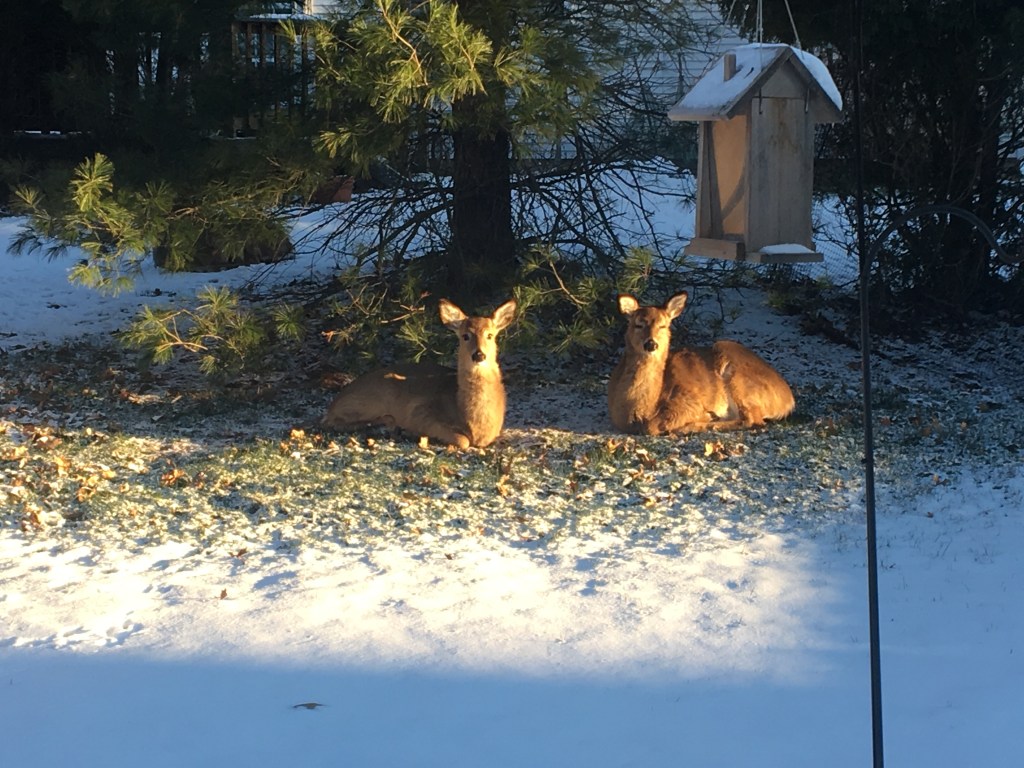
The cute photo above of deer in my backyard belies the fact that the deer crossed in front of traffic to get there. Many get hit, eventually. And if you’ve never hit a deer with your car, I can assure you that it’s a traumatic experience. The deer often gets killed, your vehicle sustains damage, and in the best case, you’re ok but rattled.
These collisions happen often. The New Jersey Conservation foundation puts the number at 15,000 to 26,000 collisions per year. The Pennsylvania Game Commission says drivers have a 1 in 36 chance of colliding with a deer. Fatalities occur every year. Purdue University estimates 1.5 million to 2.1 million deer-vehicle collisions occur annually, causing hundreds of human fatalities.
Here are the reasons behind those awful stats.
I never saw the deer, a young buck with little ivory button antlers on its head, until a half-second before I crashed into it.
There were three of them, blocky silhouettes in the pre-dawn darkness of mid-fall, standing on the gravel shoulder at the far reach of my high beams. I rode the brakes as the deer skittered across the road a safe 50 yards away, eyes reflecting in my headlights. But then a car rounded the bend ahead, its headlights briefly blinding me.
That’s when a fourth deer jumped out.
I pressed the brake pedal into the floor, and the old Blazer started skidding a bit. But the sounds of squealing tires couldn’t mask the sickening thud of bumper and grill against flesh and bone.
The impact knocked the deer onto its side and sent it skidding on the pavement. I was certain it was dead, but the little buck jumped to its feet and ran into dense brush on the other side of the road.
I pulled the Blazer to the shoulder, flicked on the four way flashers, and took inventory. Me: rattled, with a lapful of very hot coffee, but okay. Vehicle: damaged, but apparently operable. Deer: not well at all.
I dug a flashlight out of my backpack—ironically, I’d been planning to hunt deer that day and was on my way to my hunting area—and went looking for the little buck. I crunched through the brush, look for tracks or blood. Nothing. I hoped it survived, but I knew that many deer that run off after a collision eventually die.
Getting back behind the wheel proved to be an exercise in paranoia. Every rock or stump in nearby woods, every piece of trash flitting in the wind became a deer ready to leap out onto the road in front of me. I was braking for shrubbery.
Thousands of similar scenes play out every year. In 2001—tellingly, the latest year for which figures exist—20,000 deer carcasses were picked up on roads in New Jersey. “That number has to be much higher now,” notes Carolyn Gorman, vice president of the Insurance Information Institute. The fact that no agency, including her own, is able to keep track of deer-car encounters in the state tells you just how frequent they occur.
A lot of car-deer collisions occur from late October to late November, when deer breeding peaks. Males start cruising around for females. They lose some of their sense of caution and can become fixated on finding an estrous doe. They’ll walk or run right in front of moving cars and trucks, seemingly oblivious to the tons of steel bearing down on them.
Bucks will also look for does in places they’d never go otherwise. On an overcast, windy November morning last year I looked out the kitchen window and saw a six-point buck standing in front of the forsythia bushes. It was so close that I could have opened a window and flung a bagel at its head.
Seeing a deer so up close has, unfortunately, become commonplace in many areas of New Jersey. We live amid a vast Hovnanian checkerboard of houses, townhomes, and condos. My backyard measures 32 feet from vinyl siding to border hedge, and a lot of that consists of patio and rusty wrought-iron furniture. It’s not the Adirondack wilderness or a 500-acre Nebraska cornfield. So that buck looked like he belonged in the yard as much as the Weinermobile would look parked outside of Tavern on the Green during a wedding reception.
My visiting sister-in-law and I scrambled to get our phones. The dog, discovering his inner wolf, was barking and howling while throwing himself against the back door. But the buck was unperturbed. It stood there and kept looking around the backyard with an alert gaze, as if a hot doe might suddenly pop out of the Weber.
The New Jersey Division of Fish and Wildlife puts the statewide deer population at 125,000 or more. Densities—the number of deer per square mile of habitat—run from 15 to 30 in the eastern part of the state to 45 and more in the western counties. Some areas of the state have an astounding density of 200 deer per square mile.
So why is a state that’s thick with people so thick with deer? The answer lies not so much in Field & Stream, but in Better Homes & Gardens.
Deer will adapt to many types of habitat, and that found in the New Jersey suburbs is excellent. Edge habitat—which occurs wherever two different landscapes meet, such as open field to forest or, more appropriately, park woodlot to manicured lawn—provides deer with two vital needs: cover and forage. Cut down a tree in a forest, and more sunlight hits the ground, allowing new growth, which deer like to eat. Carve room for a dozen “luxury homes” out of that forest, and the effect is magnified.
Throughout New Jersey, housing developments abut farmsteads, which abut condo complexes, which abut office campuses. All those greenways and woodlots provide refuge; your petunias and cypresses provide food.
Hunting helps keep the population down, but only a limited amount occurs in suburban areas. There are a number of reasons. Local ordinances that outlaw the discharge of firearms, for example, mean only bowhunters and crossbow hunters can hunt deer. Even then, there aren’t a lot of large tracts of public land in the suburbs where hunting is allowed, which means hunters must go to private property owners and ask for written permission to hunt—and owners can be distrustful of strangers on their property with weapons.
New Jersey has taken many steps to reduce the deer population. The “safety zone,” which refers to the minimum distance a hunter must be from a building or school playground, (even if not occupied) used to be 450 feet for all hunters. Now, the safety zone for bowhunters and crossbow hunters is 150 feet from a building (it remains 450 feet from a school playground). Seasons have been lengthened, with some running nearly five months. Bag limits have increased, with a legal requirement to harvest a doe before taking a buck. Some large public spaces such as parks now conduct deer hunting programs, in which hunters register to hunt on certain days and locations within the park.
All of these efforts do help reduce the deer population, but numbers are still extremely high. That equates to more deer-car collisions, more ravaged suburban landscapes, and an increase in Lyme-disease-carrying deer ticks. That’s why the town of Princeton decided to hire White Buffalo, Inc., a Connecticut firm that specializes in removing deer from human-populated areas, way back in 2001. The company uses sharpshooters to kill deer that come to baited areas, and will surgically sterilize deer in towns and regions that prefer that route to killing deer. (White Buffalo donates all venison to food banks).
White Buffalo killed more than 4000 deer in Princeton. The town is less than 2 square miles in size.
The New Jersey suburbs are “ideal deer habitat,” says Anthony DeNicola, who founded White Buffalo. DeNicola has a Ph.D. in wildlife ecology from Purdue University and has overseen deer population reduction programs, fertility control programs, and managed hunts for deer in 20 states. He customized and deployed a deer management program for Duke Farms in Somerset County using local hunters. He points out that in New Jersey, deer find what they need—that food and cover—in a very small space. In a Hunterdon County study, the New Division of Fish and Wildlife found that the typical home range for deer is one square mile or less. That’s not a lot for an animal that weighs, on average in New Jersey, 100 to 150 pounds and can get to well over 250. If there’s food and cover around, why go anywhere else?
The Division Fish & Wildlife provides information detailing several programs designed to keep the deer population under control in areas that can’t or don’t allow sport hunting. But many of those methods cost money, which is something that the Division, and many New Jersey municipalities, don’t have a lot these days.
So when you get behind the wheel, it pays not to drive with reckless abandon. That Blazer was old when I hit that deer, and I replaced it with a big-bumpered pickup truck with anti-lock brakes and bright headlights. And cup holders.
 miketoth.net